Showing posts with label Ecuador. Show all posts

Saturday, August 8, 2015

14 Months: The Data

Miles biked: 12,019 (19,343 kilometers)
Countries visited: 11
National parks visited: 23
Bird species seen: 471
4,000+ meter (13,100+ foot) passes ascended: 4
Hummingbird species seen in Ecuador: 14
Time spent listening to podcasts about The State vs. Adnan Syed: 22 hours of 36 episodes listened to over 10 months

We're in Peru! August 4th-8th

Loja (Ecuador)-Vilcabamba-Yangana-Valladolid-Palanda-Zumba-La Balza-San Ignacio (Peru)

Sunset over Loja

August 4th
On the way out of Loja we make a visit to the Supermaxi, an enormous grocery store.  Being inside is a bit overwhelming, but I find all sorts of goodies: refried beans, nuts, couscous, chocolate bars, peanut butter, and even some hydrateable soy protein bits.

We end up leaving later than planned, but it´s worth it; our bags are full of good food.  Amazingly, the road is quiet and almost free of traffic immediately after we leave the city streets.  That was easy! A short climb brings us out of the valley, and then a long descent takes us almost all the way to the little town of Vilcabamba, where we have lunch in the town square. Vilcabamba is known for the longevity of its residents and thus has become a hotspot for retirees from North America. Around the square the foreign influence is obvious; we even find a juice bar that sells gluten-free deserts! Being surrounded by English-speaking people is rather different from the usual, and we wonder how the influx of foreigners has affected the locals. You can hardly even call the town Ecuadorian anymore.

Near the Valley of Longevity
In the afternoon we ride a series of steep hills, which I deem mini mountain passes. and reach the tiny town of Yangana. After asking around for a place to camp we end up in the yard of a house that apparently is on warmshowers! Our accommodations are not what I would usually expect from a host (lots of barking dogs, kids throwing things at our tent until we ask them to stop, dysfunctional toilet) but it's a flat, grassy place to camp and we're grateful to the family for letting us stay here.

On the way up

August 5th
It takes a little while to get going in the morning because we're purifying water and trying to fix the toilet.  We are so spoiled in the U.S. with widespread amenities like functional toilets, drinkable sink water, and abundant toilet paper. I will never again take these things for granted.

Our day starts with a climb that turns out to be a huge pass. As we pedal upwards the sun is covered by clouds and it starts to rain. Even with our rain gear, the weather near the top is pretty miserable: cold, sleeting rain, and only a few feet of visibility.

An upside to the rain: beautiful flowers lining the road
The Ecuadorian cousin of my favorite North American bird, the american dipper. From www.muddypath.com
Happily, a short descent brings us out of the clouds and we find a giant metal pipe to take shelter in. I'm pretty sure that it is a culvert they are planning on putting under the road to channel a river through. They haven´t gotten around to installing it yet, so currently that river has taken over a large section of road.  After some snacks, we start trying to figure out how to cross the river without getting our feet and legs soaked. It's chilly up here, and wet feet are something we want to do our best to avoid. We ask a truck driver if he's willing to take us across, but he says we don't need a lift, ¨just move that big log over the deep part.¨ I think he was just in too much of a hurry to help us. The log is so big and heavy that even the two of us together can't lift it into position over the river. Next, we try to make a path of stones, but the rocks are unstable and there's no way we can cross with our bikes.  Nothing is working. As we're surveying the crossing, we spot a black and white bird. It's a white-capped dipper!

I take it as a sign of good luck.  We decide that the best option is going to be to ride across.  Danny goes first, and even though he stops in the middle, makes it all the way! I'm second, and a bit nervous, but soon I am across as well, with dry feet! A good biking challenge.

Actually a different river crossing than the one I´m talking about here, but the same idea

A descent brings us into the small town of Valladolid, where we find a small restaurant for a hot, well-deserved lunch. Plantain soup, rice, eggs, potatos, and beans taste amazing. After we eat we are befriended by a small, mentally-challenged child who is convinced that Danny is his brother.  We try to be nice, but he creates quite the hassle as we try and pack up.  I wonder, where is his mom?

It's mostly a descent to the town of Palanda where we decide to stay at a cheap hotel. We'e having some issues with our brakes and need to do some maintenance. The back of a convenience store connected to our hotel becomes our bike workshop.

Part of Danny´s brakes. The arm is mangled on one side and bent on the other. How did it get like this?

August 6th
Olive oil has spilled all over Danny's frame bag, and now, thick with oil, the material has stretched out so that the bag is hitting the pedals. While Danny does his best to fix this up, I run and pick up some lunch food. We're thinking that we might make it to the town of Zumba for lunch (it's only 40 km), but it´s always best to be prepared. The bread is still warm, fresh out of the oven!
A beautiful, quiet, and gradual descent brings us out of town and into the next valley. From here we start to climb again. The road is still paved, but you can hardly tell under the thick slick of mud. Ahead, it seems that the entire hillside has caved in. Big tractors are hard at work trying to forage a driveable path through. We do our best to ride, but soon the road becomes too steep and too muddy and we're reduced to walking. We're still doing better than the buses! We watch one of them attempting to turn around in the mud bath unable to make the next turn. At the top of the ascent we have fat bikes! Our tires are so caked with mud that they appear to be much wider than they actually are.

That´s our road? How do we get up there?
Wide pavement turns quickly to...
...narrow dirt, which then turns to...
...mud. That bus was stuck.
Lots of mud. 
A muddy descent partially covered in more landslides brings us into the next valley, which we promptly climb back up out of. Near the top we stop for lunch. Good thing we brought food! We've only made it about 20 km!

Looking back, the last pavement we would see for a while

A small town marks the top of the hill and the official end of the pavement. Luckily, the dirt road is in good condition and makes for far better riding than the muck from this morning. The sun is out and shining, which makes us hot and sweaty but keeps the road dry.

Great dirt riding

A former landslide area

An incredibly steep descent brings us to the next valley, and then an incredibly steep ascent brings us out of it. Legs screaming in unhappiness, we pedal up the insanely graded road and late afternoon glide into the town of Zumba.  We're able to avoid the town center, just picking up some snacks and bread on the outskirts. Determined to get close to the border, we continue out of town.

Looking back on our road in the lower right of the photo descending down to a tiny town before climbing back up to Zumba
Our road just gets steeper. Down we go again, then back up. I'm tired and take out my frustration with the tough grades by powering up the hill like a machine. We make good time to a tiny town where some nice ladies say we can camp in the communal building (an open space with a roof and a few small rooms in the back.) Nearby we have drinking water and a functional toilet! We are happy to relax and stretch, and although people, dogs, and chickens all wander by, no one comes to bother us. It's a peaceful night.

Quite steep
August 7th
14 months ago we started our trip in Deadhorse, Alaska. How crazy is that! And how fitting that today we'll enter the country that everyone has been telling us about, that we've been dreaming and wondering about: Peru!

We start our day with a downhill, and then, guess what? We begin to climb again.  After yesterday my legs are unhappy, to say the least, but we're excited for our border crossing and so we power up the hill. Near the top we pass a military checkpoint where they check our passports and tell us that it's five minutes to the border. Haha, right. Some more uphill, a snack break, and a flat tire mean that it takes us almost an hour. Ecuador doesn't want us to leave!

There it is: Peru
The descent down to the the river that marks the Peru-Ecuador border is so steep that we can barely stop! On our way down we encounter a French cyclist on his way up. His bike is loaded down with stuff, and he is already quite red in the face from pushing, even though he´s only about 200 meters out of town. We stop to exchange some route information and offer encouragements.

It´s steeper than it looks, trust me.
There's hardly a town at the border, just the immigration office and a few small stores. The police are almost overly friendly, asking us why we bothered to lock our bikes when they're there to make sure everything is safe. Usually we try to get through borders quickly, but here we end up hanging out for a little while, eating lunch and purifying water in the shade. Lunch is supplemented by some grilled plantains for 10 cents each, a delicious send-off!
Fed and hydrated, it's time to cross the international bridge! At the immigration office in Peru we are surprised to find two other touring cyclists! A couple from Quebec in their 60s, Charles and Denise are in amazing shape and have been traveling all over South America for the last 13 months! They are loaded down with so much stuff that I don't even want to imagine pedaling their bikes. I don't know how they do it! We chat for a while and then go our separate ways.

Denise and Charles from Quebec

Setting off into Peru our road is new, smooth pavement, well-graded and almost totally devoid of traffic. Occasionally we are passed by a moto-taxi or a motorbike. These and donkeys seem to be the preferred methods of transport around here. It's fabulous to be riding on such a nice road after the steep, hilly end of Ecuador, and we can´t help but feel a bit sorry for the cyclists we met heading the other way, surely pushing by now on their horrible introduction to Ecuador.
With our good road, the only challenge is the heat. We've lost a lot of elevation and the sun is out in full force. As we begin to climb we take many breaks in the shade and drink a ton of water.
Along the way we pass several small towns. People are generally friendly and wave or greet us. It's clear that we are in the land of coffee. Everyone is drying coffee beans on large tarps spread out on the road (this tells you about the amount of traffic here). As the sun starts to lower in the sky, we watch the locals bagging up the coffee in huge sacks and loading it in the moto-taxis or on donkeys to take home. I wonder about the people in the U.S. proudly drinking their free-trade coffee from Peru and if they know it was sun-dried on a highway.

When we've had enough of the heat and our climb, we start looking for a place to camp. The only problem is that we're on the edge of a cliff! Finally, Danny spots what appears to be a flat area on a hill to the side of the road and goes up to talk to someone at a nearby house. Turns out we've found the local soccer field! There's a soccer game soon, but they say we can camp here afterwards.  All of the local kids have heard that there are gringos in town and come to observe us as we make and eat dinner and set up our tent. We try to talk with them and have some success in coaxing them out of their shyness. They tell us about all the animals they have and all the crops they grow here. There's coffee, cocoa, yucca, plantains, and a whole bunch of things I've never heard of, although it's quite possible I just don't know their names in Spanish. The lady who lives at one of the nearby houses is super nice and brings us out chairs to sit in as we eat dinner, as well as some fresh bananas which look as if they just came off of the plant. As the sun goes down we crawl into our tent to get away from the voracious bugs, and slowly the crowds go home. The night sky is spectacularly clear: we can see the Milky Way tonight!

August 8th
Happy birthday, Mom!
We don't sleep well. In the middle of the night, the dogs decide to start barking and fighting outside our tent. Even though Danny goes out to threaten them with a swinging arrow, they still don't stop. This ruckus wakes up the donkey and the rooster. What happens in small farm communities like this is that once one animal is up, all the others feel like they have to join in. Thus, our rooster woke up the rooster at the next house which woke up the rooster at the next house. etc. In the morning we get up early and pack up quickly, determined to make it to the city of San Ignacio and take a rest day.

Some gradual climbing takes us up over the top of our pass and by 9 am we have a cheap place to stay in the city. Time for errands!
1) Get breakfast. The waiter at the restaurant we go to is extremely confused that we don't want one of the meat dishes on the menu and has to go back and forth to the kitchen three times before it's settled that we can have a plate with rice, eggs, and yucca. Looks like we're back to our Colombian diet of rice and eggs when it comes to restaurants.
2) Re-stock first aid kit.  This is a bit of a challenge when you don't know how to say iodine, band-aids, or gauze pads in Spanish, but we did our best.
3) Figure out cell phone charger.  Peru and the countries south of here have different outlets, but apparently our current chargers still work. Hooray!
4) Go food shopping. No Supermaxis here. Visiting a bunch of small shops and the local market leaves us with a huge pile of fruits and veggies, instant pasta, some pretty good looking aged cheese, bread filled with seeds, and a huge bag of mixed, pre-cooked beans with spinach-garlic sauce. Yum!  We were definitely spoiled by the food available in Ecuador, but I think we'll do just fine here.
5) Avoid moto-taxis. The taxis here are decorated in the same style as Central American chicken buses: plastered with gaudy decals, streamers, and brilliant colors. Since the driver is on a motorbike, I think they forget how wide their taxi on the back end is and always cut it too close.

This afternoon is for blog updating and relaxing. More adventures tomorrow!


Monday, August 3, 2015

Out of the Oriente, July 30 - August 3

San Juan Bosco-El Pangui-Gualaquiza-Yantzaza-Zamora-Loja


A centipede washed out by the rain
It rains every night here in Ecuador´s oriente. On July 29, camped at a tiny police station at the edge of an equally tiny town, we were sitting in the tent talking when we heard a low thundering sound. The area around us was still dry for the moment, but the sound grew into a roar as the rain reached us, falling in sheets all around. It was so loud we could no longer talk, so we let it lull us to sleep.


The next morning we set our sights on Gualaquiza, a large town not too far but on the other side of some pretty big hills. We tackled the ascents slowly and steadily, and around mid-morning the rain began again. Our experience here in the Oriente, the part of Ecuador east of the Andes, had been that the rain comes and goes all day but never for longer than about twenty minutes. So, expecting it to stop, we didn't put on our rain gear, but unfortunately it didn't stop. For over an hour it poured, and we happily found that we enjoyed the long ascents because our movement kept us warm. Finally, reaching the top much sooner than we otherwise would have, we zipped our rain layers over our sodden clothes and descended down to sunny, low-lying Gualaquiza to get some hot chocolate.

About a month ago, we were adopted for a night by a nice guy, Mario, near Ibarra in northern Ecuador, and when I mentioned to him in an email that we would be passing through Gualaquiza, he told me that his brother-in-law lives there and would be happy to take us in for the night. We met Leandro at the centro, where he drove us out of town to his father-in-law's place. Rafael, the father-in-law, runs a hotel/retreat center with private cabins for guests to stay in, all landscaped with fragrant flowers and set among lush forest. He told us to make ourselves at home in one of the cabins, a big step up from our tent! (In case you're lost, we were at the cabins of the father-in-law of the brother-in-law of the guy we met a month ago outside a supermarket. Okay.) We immediately took out all of our things and spread them everywhere; the past few days and nights of continuing humidity were beginning to take their toll.
Our house for the night
Our restful night transitioned easily into a delicious breakfast and more conversation with Rafael and Leandro, and then we hit the road again. The road from there to Zamora, about 70 miles away, was apparently flat. We knew better - there's no flat in Ecuador - but there weren't any mountain passes, that much we knew. Between the good road and our desire to move south, we busted out the 70+ miles without too much trouble, arrived late in the day, and camped, urban style, at the municipal government building in Zamora. Of special note was dinner: ramen noodles, red beans, pink beans (whatever those are...), chia seeds, onion, red pepper, tomato, olive oil, and oregano/black pepper/garlic seasoning, all eaten with tortilla chips. Chocolate and peanut butter for dessert. Mmm!

The next day found us at Parque Nacional Podocarpus, a stone's throw from Zamora but in the middle of dense primary forest. It feels like wilderness; you would never believe there´s a city nearby.

Waterfall along the scenic road to Podocarpus


We arrived in late morning, stashed our bikes in the woods, and went for a walk down to the river. Only a few bird species were out and about, but we were able to find the one-of-a-kind amazonian umbrellabird! It's all black, like a large crow, with an impressive crest that looks like an umbrella.

Umbrellabird habitat
On our way back to town, we stopped at an eco-lodge and asked if we could camp there, and the friendly owners said yes! Little did we know, Copalinga Lodge is a private reserve widely known as a bird and wildlife hotspot. Their feeders (bananas and sugar water) attract all kinds of incredible bird species from brightly colored tanagers to funny, chicken-like chachalacas and tiny, brilliant hummingbirds. Tam and I sat watching the show all afternoon, content with our decision to spend the day there and thankful to the friendly owners of the lodge for having us! If you are into birds at all and are in the area, check out Copalinga! It is a natural paradise.
Green Honeycreeper
Violet-fronted Brilliant

The upside of camping in a bird reserve is that you can wake up, walk out your front door (or crawl out the vestibule, in our case), and find yourself surrounded by birds! No transportation necessary. Before beginning our big climb up to Loja, we were able to spot a few new species and have a nice chat with some birders from Texas.

Golden-eared Tanager
There´s something meditative about a big climb. No need to shift gears or worry about route choice. Just get the legs pumping and go up and up, feeling the temperature change slowly, watching the clouds get closer and the rivers and valleys fall away, breathing deeply and rhythmically, setting into a constant cadence. After a few hours, however, we were excited to reach the fog of the paramo and see Loja far below in the next valley. All in all, according to cycleroute.org, over 35 miles we ascended 9,958 feet and descended another 6,233. Quite the climbing day!

Arriving in Loja, we found a cheap hotel where two other travelers, Julia and Hannes, were staying. Having cycled from Alaska as well, they have had similar unique experiences to ours, and we stayed up late with them sharing stories and eating, of course.

Hannes and Julia, fellow cycle tourists from Germany

We´re spending August 3 in Loja and will be heading south from here, Peru in a few days!


Area notes: The road to Podocarpus is about 6 km, a smooth and scenic dirt road. Entry to the park is free, like all Ecuadorean National Parks. The road terminates in a trail - there´s nowhere else to go - and a 30 minute hike brings you to the visitor´s center, a map, and some other hiking trails.

The bomberos in Zamora share a building with the municipal government, so they don´t have space to host cyclists. We did stay at the building, however, just under the watch of the general security guard. Because the space is shared by so many different organizations, no one seemed to care about our being there. If you want to do the same, save time and simply ask the security guard at the front rather than heading upstairs to find the bomberos.

Zamora to Loja: Big climb, no shoulder, not too much traffic. There are streams everywhere for water.

In Loja we stayed at the Hotel Londres at Sucre 07-51. For $6 per person, it provided a bed, Wi-Fi, and a central location from where we could run our many errands. Bicimania, also in Loja at the corner of Colon and Emiliano Ortega, is a well-stocked shop with helpful service.

Wednesday, July 29, 2015

Mudslides and More, July 25-29

Riobamba-Lagunas de Atillo-Macas-Sucúa-Logroño-San Juan Bosco

From Tam´s journal:

July 25th
We plan on leaving today, but when we wake up it's already 9 am, and then breakfast goes until 11. We decide that it can't hurt to spend one more day with these wonderful people.  It's a true rest day: we stay in, share photos and stories, and write postcards.  Most importantly we enjoy wonderful meals with our host family!

July 26th
It's a slow morning, with breakfast, goodbyes and photos.  Who wouldn't be reluctant to leave such a homey place? I feel like just in the last two days we've become part of the family. Borja, Nathalie, Luci, and Pubi, we can't thank you enough! And of course saludos to Mati!
Immediately out of town our road has a large shoulder and I barely notice the traffic.  As we climb away from the city the shoulder diminishes in size, but it doesn't matter because the traffic is so minimal. A number of road cyclists pass us on the climb, and we're happy to see others out riding. Riobamba fades away below, and we look back to see it nestled in the valley. Adios!
Our road begins to follow a large gushing river up into the mountains. Unfortunately, instead of gradual river grade, we have a series of steep ups and downs, climbing up to small rural towns, then descending down to the river.  Most people we see are friendly and wave.

The river we followed for a while up out of Riobamba
Along the road are frequent signs explaining why we need to protect the environment, bumps to slow down cars, and crosswalks.  It seems ridiculously overdeveloped considering how few cars there are and the extremely rural population, many of whom probably can't read well and have no problems crossing the road wherever they want.
The weirdest thing we see all day? A giant roast pig hanging outside of a small store. Gross.
It has been a long day of climbing, and we're tired, but we push on, determined to reach Sangay National Park. I'm glad we do.  Just at the park entrance are the famous lagunas that we've been told about.  In the setting sun there's a rainbow, and the mountains around the reflective lake clear a bit to reaveal a dusting of snow on their peaks.  Across from us a huge waterfall thunders into the lake. Everything is spectacularly serene.

Lagunas de Atillo, Sangay National Park


July 27th
It rains all night and continues in the morning, which does nothing to increase our motivation to get going. At 9:30 we finally hit the road--still raining. Some ups and downs bring us past more mountain lakes, but unfortunately we can't see much because of the clouds.  Then we begin to descend in earnest. Almost immediately the vegetation becomes thicker and more lush.  Waterfalls, big and small are everywhere. Some are so huge that they would be the main attraction somewhere else, but here no one cares; they are nothing out of the ordinary. I feel like I'm biking through a flood.  The rain, the waterfalls, the rivers. Water everywhere!
The road is paved the whole way, but we encounter a land or mudslide every few minutes. Some are just rocks in the road, others are huge piles of dirt, trees and rocks, still others are full out rivers flowing across the road.  (Luckily these rivers are never more than a couple inches deep.) In some places I can see why there has been a mudslide, as the bank is already far too steep and muddy.  In other places it looks as if a small river has flooded and washed all the material from its banks out into the road. And in some places gentle banks covered in green vegetation have simply caved in, given way. Why? I think everything is just too wet.

Avoiding a mudslide
We get to watch one mudslide in action. We pass through a pile of thick mud on the road, and then turn back to the sound of the hillside puking. That's what it sounded like. Gurgles and sloshes send down a big mass of brown mud, which proceeds to slowly ooze out into the growing mass on the road.
A few other interesting things we encounter on the way down.
1) An earthworm that we thought was a snake because it was so big! Probably 3 feet in length! (Danny moved him off the road to safety, don't worry.)
It dwarfed my one liter water bottle

2) A tunnel that's almost a kilometer long! Thankfully it is well lit and a nice break from the rain... although it's raining in some places inside the tunnel as well.
3)Lots of birds! We hear them singing everywhere, but as you can imagine, under the conditions it's hard to get a good look at them.

Late afternoon, the rain finally stops and we can take off all our layers. A bit more biking, and we're happy to find ourselves in the large town of Macas.  The firefighters all seem to be in a bad mood but let us camp inside at their station. Awesome! We hang up things to dry and go out to do some shopping. Im feeling excited.  Today was unlike anything we've biked yet on this trip.  We're in the Amazon rainforest!

July 28th
It starts raining overnight and we discover that the roof is leaking right over where we are sleepíng.  Time to relocate! Luckily there is plenty of space in the room we´re camped out in. The upper floor of the fire station has clearly not been well designed. Besides the ceiling leak, there is a fume hood but no stove, toilets and electric hand dryers but no sinks, and a urinal on the wall that isn´t actually hooked up to any pipes.
At 4 am, we hear what sound like gunshots.  Oh wait, it's only the nearby church shooting off fireworks and broadcasting mass. I will never understand the way religion works here. We put in our earplugs.

In the morning we're on our way on a well paved road. At first we are traveling flat to downhill, and just cruising! It has been so long since we've been on a fast road like this!
Slowly, things get more hilly.  Every time we cross a river (frequently), we descend steeply down to it, then climb steeply back up.
We pass a lot of small towns and houses, and I'm surprised by the fact that the majority of houses are really nice. We see smooth walls, colorful paint, multiple floors, covered balconies and huge flower gardens. I imagine that some of this is simply a result of wood being so readily available here. Despite the development, we enjoy quite a lot of jungle as well.  As soon as you look out past the houses, there is layer upon layer of dense forest. Even the farmland is barely recognizable because everything looks overgrown. It must be quite the struggle to try and clear a plot of land here.
In the afternoon, the sun comes out and dries off our stuff a bit. Its heat and warmth are welcomed until we start to sweat. It's humid here!
Our road brings us down to a great confluence of rivers. Below us we can see them mixing, the murky brown of one swirling with the almost black brown of the other.

Chocolate and peanut butter, mmmm
We can see that we've left the drainage of one and are about to climb up into the drainage of the other. After some very steep, slow climbing, we stop at a farm house and ask to camp under a small shed area.  The lady is very friendly and tells us about how they ranch cattle, then leaves us to set up our stuff.  We're really just excited to have a roof to put our tent under, since it seems to rain every night.

As we're eating dinner, something strange happens: we see another cyclist ride by in the other direction. Since we haven't seen another cyclist since northern Colombia, and we're both pretty tired, we simply sit and watch, a bit dumbstruck, as she rides by.  Once she's past and going down the hill, we start kicking ourselves for not running out and saying hi.  I wonder where she was going?

July 29th
We sleep well and head out early in the morning.  A bit of misty rain and clouds is keeping things cool.  Our road is absurdly hilly.  I feel like we're climbing more here in the Amazon than we were in the mountains! Today there are less towns and more dense forest.  We pass more waterfalls, rivers, landslides, and beautiful flowers. Still haven´t identified the new birds we saw... but there´ll definitely be some new ones for our list!
Jungle riding
Fresh bread with creamy avocado and cheese for lunch, then up and over some more mountains and into the town of San Juan Bosco for the night. We're in early, which means we have time for shopping and blog updating!

So, I was expecting to find lots of fresh fruit here in the rainforest, but the little stores we pass only sell candies and bags of chips. Maybe it's not the right season, or maybe this is a symptom of too much globalization. We also listened to Katy Perry blaring from a gas station today.  Where are we again?
The rainforest!


Route Notes:

- Riobamba to Macas: There are a few unpaved options after the main road out of Riobamba, but we stayed with the pavement all the way. Not too much space, but not too much traffic either. It also helped that we left the city on a Sunday. We weren´t sure if the road would be open because of recent landslides and continued rain, but the twitter page of the Ministerio de Transportes y Obras Publicas (MTOP) indicated the road was cleared a day before. It was open, though still full of landslides, and well-paved all the way to Macas.
- Macas to San Juan Bosco: Paved and quiet with plenty of small towns and houses along the way and rivers everywhere for water. Really nice bomberos in Limon Indanza, about halfway between Macas and Gualaquiza -- we didn´t stay there, but one of them saw us eating lunch and offered to let us stay at the station that night -- and police/bomberos in San Juan Bosco.

Friday, July 24, 2015

High Passes and Potatoes, July 20-24

Zumbahua-Angamarca-Cunuyacu-Riobamba

July 20th
We sleep in a bit under warm wool blankets in the church dormitory, so when we finally set forth the sun is shining bright in the sky. We stock up on food provisions and climb out of town on a beautiful paved road. Slowly the valley drops away below us. The many fields look like pieces of a well-loved quilt strewn amount the rocky outcroppings, and lining the road are the highest altitude cacti I have ever seen. Did you know that cacti can grow at 12,500 feet?
Up, up, up, mountains, mountains, mountains 

Near the top of our winding climb we spot signs for the road we will take to Angamarca. Time to let some air out of our tires and get back on the dirt! The road is bumpy in places but generally in awesome condition, and gradually it takes us up higher into the mountains. Up here, the most common farm animal, the cow, has been replaced by herds of llamas and sheep, which are much cuter and fuzzier. The llamas look at us with their huge eyes as we ride past and I get the sense that they are staring into my soul.

Perfect cycling
A mosaic sheep
Out for a walk with the pig
At the top of the pass we reach a new record for highest elevation biked: 13,500 feet! Exciting!
A gradual descent brings us down to a river, then we climb up our second pass of the day. Near the top things get really foggy, and suddenly a rather ephemeral church emerges from the mist. A nice landmark for the top!

The only building for miles
For the beginning of our descent we are cloaked in mist. Everything is completely silent except for the bumping of our bikes. Slowly, farmland begins to emerge again and soon we find ourselves in the quiet town of Angamarca. Not much is happening in town, so we buy some food and then head out. The descent to the river is easy, but when we reach the turn-off for the road that will take us to Simiatug the road begins to climb up steeply. The dirt surface is packed enough that we can ride, but it's so steep that we pause at the top of each rise, gasping for breath.

Dodging a cow on the descent
Angamarca way below
As we're stopped looking for places to camp, I start talking to a local guy, Jose, who says we can camp beside his house. A very friendly guy, he shows us to his place where his family proceeds to observe us with great interest as we set up our tent. We chat with them for a while and then have an early night.

July 21st
We wake up early to the various noises of a farm community. Donkeys braying and whistling, roosters crowing, dogs barking, babies crying, etc. As we're packing up I ask Jose if they have a bathroom I can use. No, he says, they don't have a bathroom. They explain that missionaries who have been living and working in this area helped them build this house, but they haven't started the bathroom projects yet. Inside the house I can see a TV, and I wonder why this had priority over a bathroom.
The start of our climb is steep and tiring but rideable for the first few kilometers. Then, we reach an impasse. Someone has dumped a layer of large loose rocks on the road. We assume this was meant to improve the road surface, because why else would you purposely cover the road with rocks and line the sides carefully with larger boulders? Considering the steep grades, we can't ride on them. The local donkeys and horses that are sharing the road with us don't seem to like them either. They pick their way along small grassy dirt paths by the roadside and we do our best to follow.
Hooves > Wheels

With the challenging conditions, we end up pushing our bikes up a good portion of the road and are ecstatic to finally reach the top. From here the road is more gradual and has a more manageable surface. I can't believe people are still living up here at this altitude. The dwellings we see are mostly short huts with mud brick walls and some sort of straw/hay layered heavily on the roof. I imagine the more the better for insulation.


We stop at a "micro tienda" (tiny store), the only business we see all day, for some snacks. The ladies running the place are very fashionable and very excited to see us. I don't think they get many customers up here.
Shortly after, we stop for lunch at the edge of a huge green valley, as we sit with our backs against a row of pine trees, we watch clouds flow in an out of the valley. I don't know if I have ever seen clouds like this. Thin and wispy, they're blown into beautiful configurations by the wind, twisting in waves and spirals. I could watch them all day!


After lunch we leave the hot sunshine and climb up into the clouds. I can assume that we're surrounded by more farmland, but I can't see anything, just white mist! It is gloriously quiet and peaceful. At some point we reach a top and begin to descend, then we reach the bottom and start going up again. I'm tired from all the climbing, so we stop a bit early to camp outside of a school. As we set up our tent, a group of kids watches us silently, clearly interested in us but too shy to talk. After a long while, Danny finally gets them to engage in a bit of conversation. When we ask what their favorite food is, they all say potatoes. I don't know if they eat anything else here. 

July 22nd
It rains all night, and in the morning, it's still raining. A bunch of small ladies come over to talk to us. Turns out that they work at the preschool we camped behind and are curious about us. They invite us inside for some eggs and hot coffee/panela (sugar) water. While we're waiting for breakfast to be prepared, we help them with a project that they're working on: cutting out small, brightly colored foam hands. They tell us that today the kids are going out for a walk with the hands for some sort of special event. The hands represent that everyone has rights, to combat the internalization of indigenous prejudice. Quite a statement for pre-schoolers! I'm happy to see that these people care about education and opportunity for the little ones in these far-flung communities.
When the ladies set off to collect their students, we leave as well on our bikes. It's muddy and raining but there's a spectacular rainbow emerging from the valley!


"Have a good journey"
We pass by a number of small houses, and at one point Danny, stopped to fix his helmet, is approached by a guy who says, "Go fast." Danny, thinking he's making a joke about how slowly we travel, says no, we travel slowly on bikes. Suddenly the guy reaches out and shoves Danny, and we realize that he is extremely drunk. We start pedaling and get out of there as fast as we can, calling back that we'll be passing through quickly.
Worse, up ahead is a whole group of clearly drunk men. Before Danny can say "buenos dias," one guy says, "Regálame alguito." Give me something. We know we're in for trouble. We try to accelerate through the group, but they are blocking the way. One man kicks my front tire and another grabs my backpack, but they are uncoordinated and we are quickly past. Rather unnerved, we are more than happy to pedal up into the paramo and away from the houses. We don't think those guys were really ill-willed, just incoherent and looking for trouble, typical drunk man behavior.
Soon our difficult morning is forgotten in lieu of more pressing challenges. The wind and rain pick up and envelope us in a freezing high-altitude storm. At times the rain turns to snow. We are reduced to pushing our bikes, heads down against the barrage. It's tough going, but we don't want to go back to the drunken celebrations, and we certainly don't want to stop here. We push on. We don't have any photos from this section; for Danny to take his camera out would have spelled the end for the camera.
Eventually we reach a giant cross marking the top of the pass, barely visible under the awful conditions. We take a couple seconds to celebrate a new altitude record: 13,877 feet! Then we head down. After a bumpy, cobbled descent we reach the "town" of Cunuyacu. Really it's a collection of a few small buildings and some swimming pools. These are what we're excited for: natural hot springs fueled by thermal activity from the local volcano! We find a tiny room at the local hospedaje (really a house with a few small rooms for visitors) and chow down on enormous bowls of steaming eggs and potatoes. Then it's to the hot springs for the rest of the afternoon where we soak gloriously for hours.
At the hot springs we meet a family from a local town who explain to us that every town in the area has a day each year when they celebrate the anniversary of the town, the town "birthday." Their local tradition is to come to the hot springs. We speculate that this explains why all those men were drunk this morning - at 10 am on a Wednesday - and hope to avoid all town holidays in the future.
The plan for dinner? More steaming potatoes and eggs. As we wait for the food to cook, I help the ladies shred pieces of old white shirts to use as gentle sponges for cleaning cars which they sell here at the shop. With a few picks of a dull serrated blade the material comes apart in delicate curlicues in their hands. I whack away until little white pieces shred off. How can destroying a shirt be so difficult?
After more filling food, we're happy to have a warm night inside out of the rain and mud. All of our stuff is soaked. 

July 23rd
In the morning it is still cloudy and raining so we're reluctant to leave, but we want to restock food in the big city of Riobamba so we set off.
Not-so-encouraging morning weather

Miraculously, as we begin to ride, the sun starts to peek out of the clouds and a tailwind picks up. We yell out encouragements to the good weather. "Come on sun, you can do it!" Our paved road makes a gentle ascent up to the turnoff for Chimborazo, the tallest peak in Ecuador. Fun fact: the top of this mountain is actually earth's closest point to the sun due to a topographic bulge at the equator. As we ascend to the volcano, it is still cloudy and rainy at points, but compared to yesterday, it's perfect riding. There are lots of vicuñas, small, llama-like creatures, out and about. Their funny long necks and gorgeous fur billowing in the wind make them fun to watch, and they're easy to see in the barren landscape. Our high-altitude surroundings, in fact, remind me of the desolate Mojave Desert in California. There's nothing there, or here, but it's perfect for these strange creatures.


At the foot of mighty Chimborazo we reach yet anther altitude record: 14,448 feet! We stop at the small visitors center to get out of the wind and enjoy a view of the snowy base of the mountain which has finally emerged from the clouds.
Volcan Chimborazo, 20,564 feet high 
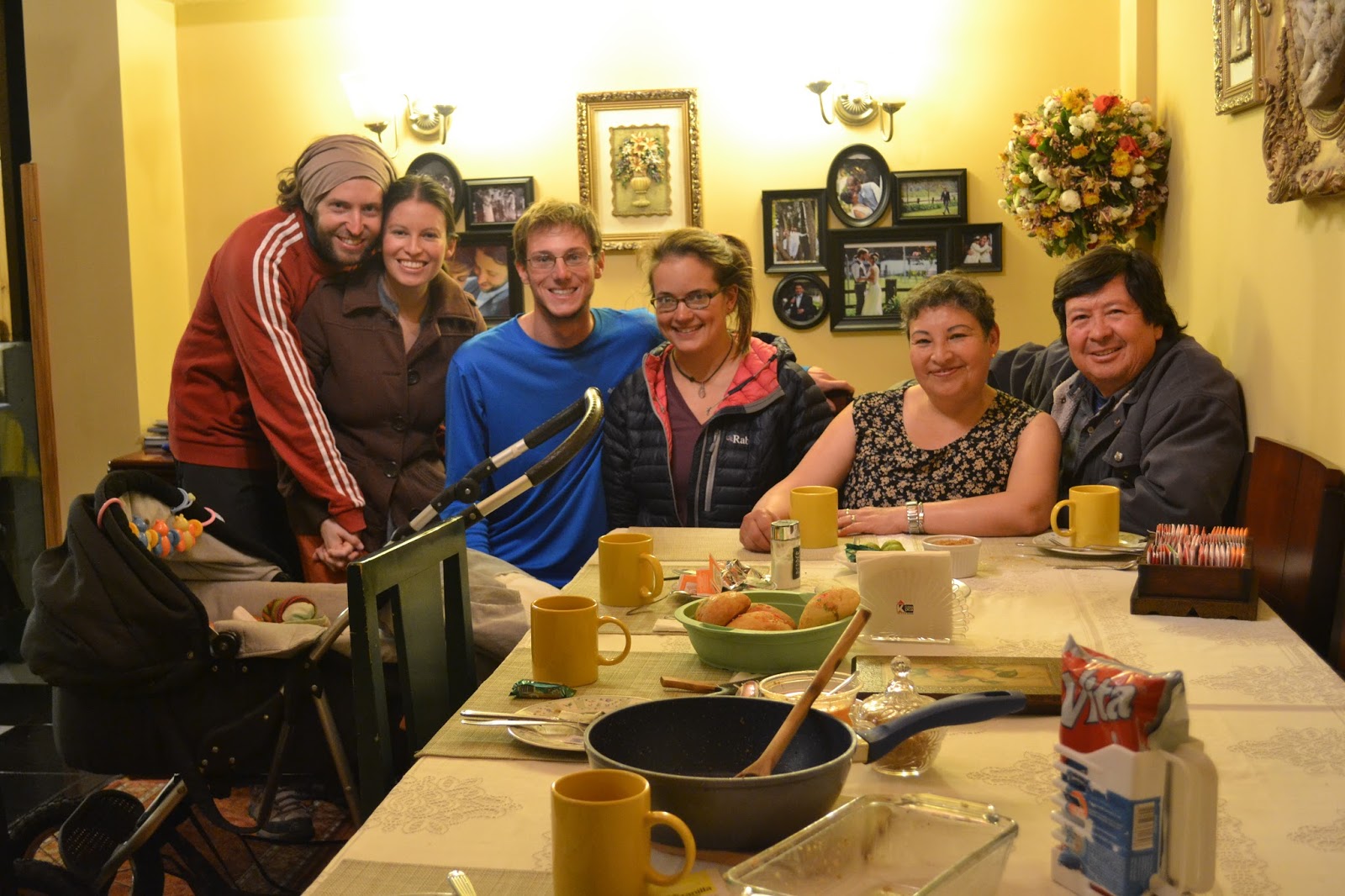
The road to Riobamba is almost completely downhill. It's a beautiful and speedy descent on pavement. Once in town we get some bread for a late lunch and find the place of the warmshowers hosts we contacted. In a short while we are welcomed into an amazing family, Borja, Nathalie, their adorable new baby, and Nathalie's parents Luci and Pubi. They welcome us in with hot showers, a washing machine, and later a delicious meal of traditional Ecuadorian food and chocolate. I think we are the luckiest people in the world.


July 24th
Rest day in Riobamba! Time for shopping, shoe fixing, bike cleaning, blog updating, route planning, and most importantly eating too much ice cream!

Ice cream with Luci


We found a zapatera to fix our worn-out shoes

Sunset over Riobamba
Route Notes:
- Zumbahua to Angamarca: Smooth, paved ascent out of town. Take a left near the top of the climb (it's signed for Angamarca) and find a scenic, well-surfaced dirt road topping out around 13,500 feet. There's a descent into a beautiful valley, another climb, then a bumpy downhill to the town.
- Angamarca to Cunuyacu: We took the squiggly but relatively direct road on Open Maps (MotionX Terrain), descending to the river on the route to El Corazon and hanging a left steeply uphill just before crossing the second bridge. The map indicates that the left next to the bridge links up with the desired road via nothing more than a narrow trail, but numerous people told us this was the way and indeed it was, an easy-to-follow road the whole way. At one point, as you near Simiatug, there's a fork; go left, uphill. At the second fork, really a T-junction at a switchback, take a right to descend to Simiatug or a left for Cunuyacu. The surface was generally good, though some parts had tons of large, loose rocks that made riding downhill a bit sketchy and demanded some pushing on the steep uphills. After the initial ascent out of the river next to Angamarca, the road surface got better. Cobbles on the last part of the descent into Cunuyacu, but it's worth it: hot springs await!
- Cunuyacu to Riobamba: Follow the Antigua Via Flores uphill until it meets up with the Ambato-Guaranda highway. Good shoulder on that road, some traffic but not overwhelming. A left into the park - there's a sign for Riobamba, 51 km - brings you up to a high pass then way down on the other side. All good pavement, the occasional car, and a lot of vicuñas.