Sunday, July 5, 2015

Galapagos!!! June 28 - July 6

Blue-footed Booby, the quintessential Galapagos bird
June 28 and 29, 2015 - Quito

I am Danny’s mom and the guest blogger today. Steve and I met Danny and Tamara in Quito, Ecuador. During the day and a half we had in the city, we got a chance to see some of the sights. Everyone is very excited because the Pope will be arriving on July 6th and will be here for four days. Danny and Tam rode by the old airport where the Pope will be giving mass. There are huge Jumbotrons set up so that everyone will be able to hear and see him. We stayed at a small, boutique hotel that had once been a rest station for visiting nuns.

The city has a Spanish feel to it with flowers on balconies and ornate architectural features on buildings. It was fun observing the people, especially the indigenous ones with their traditional fedoras, colorful clothing and gigantic straw baskets or babies on their backs. We couldn’t help but notice the number of churches concentrated in the Old City! One huge church, the Basilica del Voto, covered an entire block. Along the top of the church, instead of the normal gargoyles, there are fanciful stone images of animals found in the Galapagos. What fun to discover turtles, iguanas, crocodiles, monkeys and dolphins looking out at the Old City. We loved these whimsical creatures more than the traditional gargoyles.

The four of us mostly stuck to the Old City, peeking into the bakeries, jewelry stores, phone stores, florists, toy stores, flower shops, and stores selling dried herbs and enormous sacks of flour. A surprising number of police were congregated in front of the presidential building to make sure that the evening marches remained peaceful. One group is in favor of President Rafael Correa’s current policies and the other is protesting against them.

Later in the afternoon Steve and I happened upon La Ronda, an artsy street that offers a variety of restaurants and charming shops.


June 30, 2015 - Quito, San Cristobal Island

After a filling and typical Ecuadorian breakfast of bread, eggs, yogurt and fruit at Portal de Cantuna, the four of us headed to the airport to begin our Galapagos adventure. The flight from Quito was uneventful until we arrived at San Cristobal. We were subjected to the most thorough passport and immigration check we had ever seen — and this was all for a domestic flight.

Sea lions joining our morning talk
While waiting for our dinghies at the wharf, we were entertained by the sea lions frolicking in the water, sunning themselves on the rocks and sprawled out on the benches. They looked very comfortable and paid us no attention unless we came too close to them. Then they’d chase us! Fortunately, they are not that fast on land. 

The Odyssey is a lovely ship with roomy cabins. We didn’t anticipate that amount of space so it was a pleasant surprise. The naturalist took us to see great tortoises — we saw one that was about 4’ long. It totally ignored us even though we were 6 feet from it. In the ’80’s the parks department built a special spot called a breeding ground because 85% of the tortoises had been eaten. Now the parks department moves the eggs that the female tortoise lays and moves them to a warm spot until they hatch. The eggs are the size of tennis balls. When the baby tortoises are about 5 years old and have a strong enough shell to protect them from predators, they are gradually introduced into the wild.

While we slept that evening, the Odyssey motored to the next island, Española. Steve and I woke up in the middle of the night as the boat lurched from one side to the other. It took us a while to get used to the movement and then we were fine for the rest of the trip. The motion woke up Danny and Tam, but apparently not for long.


July 1, 2015 - Española Island

Taking a nap
Not a cloud in the sky as we left for the morning walk. A bull sea lion had established a harem at the pristine, isolated beach where we landed. There were 30-50 female sea lions flopped over each other on the pure white sand, basking in the sun. Every now and then a competitor would show up and the bull had to fend it off by chasing it out of the area with threatening barking noises. What an exhausting job keeping out the competition!  

The ground was flat but there were a lot of lava rocks on the walk, and it was tricky stepping on and over them. You never knew when one would move underneath you. Along the way Christian pointed out an “airport landing area” for the albatrosses who lay their eggs throughout the area. After six months with their parents, the baby albatrosses are ready to fly on their own in the wind currents. What fun to watch them, along with the hawks, take flight from the top of the high rock where we were standing down to the ocean below.
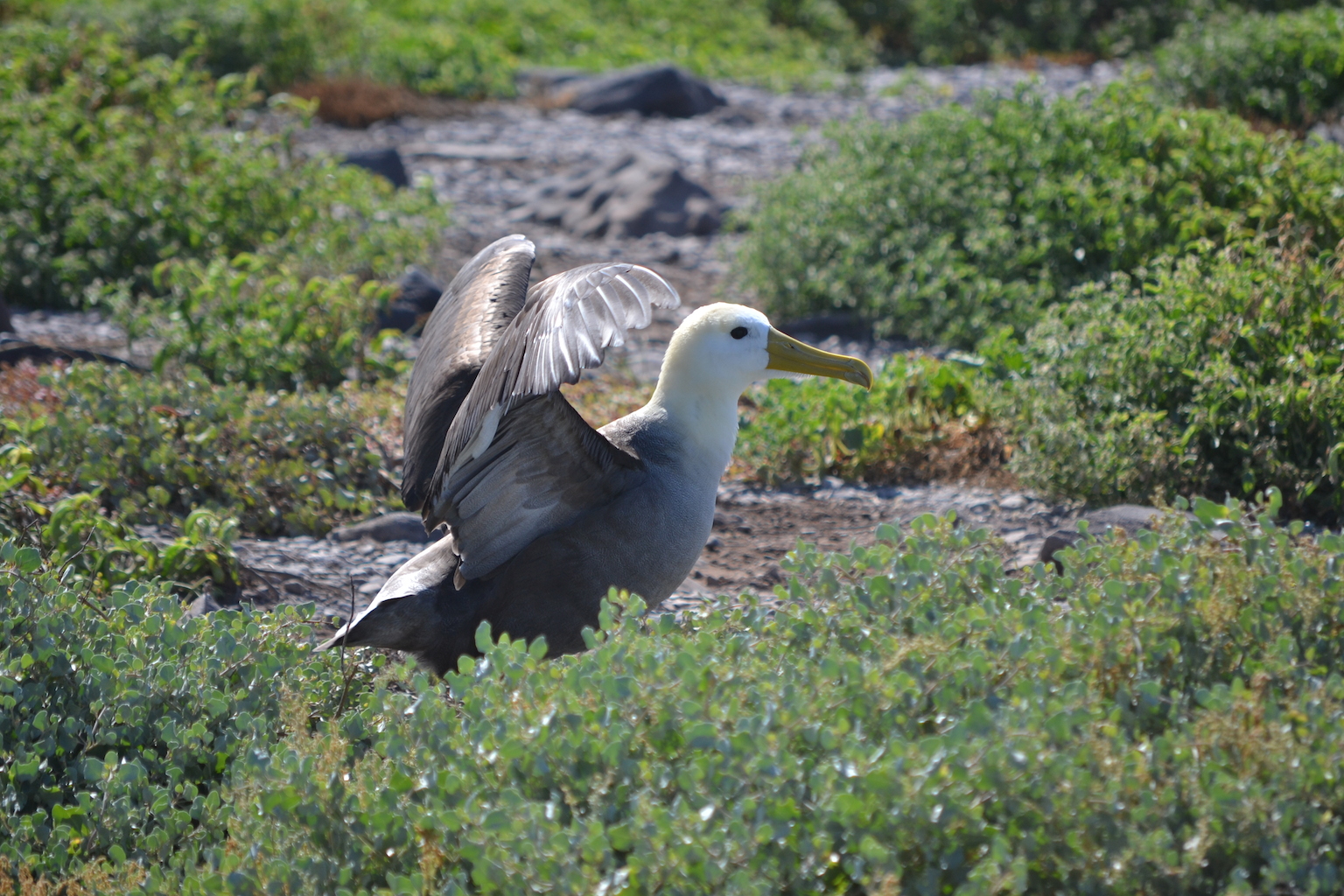
Waved Albatross
Farther along the coastline, as we approached another area , we could hear the water hitting the rocks and then could make out huge sprays of water. whooshing 20 feet into the air. They reminded me of the Yellowstone geysers. That’s where we came upon red, colorful Sally Lightfoot crabs scurrying over the rocks, alongside numerous iguanas. They were everywhere we looked. The males’ crest extends the length of their back, making it easy to distinguish the two sexes. 

In the afternoon we snorkeled and admired a variety of colorful fish. At some points there were hundreds of schools of small blue fish. A few people dove way down, including Danny. Several had underwater cameras and showed us their videos and pictures in the evening. The water was a perfect temperature although Danny needed a wetsuit because he has no insulation! As the sun was setting, we walked on the beach enjoying the incredible sunset and watching the sea lions. Adorable and very social, they frolic in the water and swim along side people. As awkward as they are on land, it’s quite the opposite in the water where they are graceful and lightning fast. 

The "blowhole" on Espanola

July 2, 2015 - Floreana Island

Greater Flamingos
The highlight of the morning was seeing 6-8 flamingos, some standing on their spindly legs and others balancing on one. Steve and I have seen them before but never this close! There were mangroves that helped protect the animals — once they tucked in, other animals cannot find them. Christian explained that the green sea glass on the beach was created when volcanic ash explodes to the air. The sandalwood trees on the island give off a scent that can be used as a  mosquito repellent or incense. 

Snorkeling was at Devil’s Crown where we saw starfish and, again, many colorful fish along with a sea turtle swimming on the bottom of the sea floor. When it surfaced for air, Danny dove down and swam with it, which he described as a surreal experience. 

At the end of the day we mailed our post cards at the “post office,” which is just a barrel. Years ago anyone heading in the direction of the address on the card would take it with him and mail it for the person who was sending it. That was the way that mail made it back and forth from these islands. It could take years to receive word that a loved one was safe. Steve and I were disappointed that we didn’t see any cards for Atlanta, GA, or, for that matter, anywhere in the southeast. Oh well.   

Another spectacular day!
Sunset scenery from Floreana
And... penguins! Our guide took us on a special trip to try and find one of the maybe five penguins living on the island, and we found two! A juvenile and an adult.
Galapagos Penguins


July 3, 2015 - Santa Fe Island, South Plaza Island

The day dawned overcast and a little threatening, but the clouds soon burned off — leaving us with another temperate and sunny day filled with activities we’ll tell you about shortly.  This is Steve, Danny’s dad, who has the privilege of being the guest blogger for the day (I was given this honor because today is also my birthday).

We first traveled by Zodiacs the short distance to the island of Santa Fe and landed on the beach in the midst of an immense colony of sea lions.  We were thrilled to be that close to these wondrous creatures but they pretty much were uninterested in us.  In fact, we had to be careful not to step on the resting animals spread out all over the beach.  The exceptions to this were the alpha males who were not happy having us this close to their harems and were prepared to let us know their point of view.  These large males could be intimidating as they sat up and bellowed at us. 

After threading past the sea lions and iguanas enjoying the beach we returned to the boat for lunch and then snorkeled and kayaked for the first part of the afternoon … then back to land where we made our way up a trail past iguanas, boobies (yes that is the name of the birds), frigate birds, crabs, iguanas, lizards and other amazing subspecies found nowhere else on earth. 
Swallow-tailed Gull, South Plaza Island

At the top of the hill overlooking the ocean were more sea lions, but in three distinct groups. On the beach the sea lions grouped mainly by harem: One bull, his females and their pups.  Here the sea lions were grouped differently: bachelor males who were not yet powerful enough to command their own harem (the “wannabes”), old males who could no longer defend their harems (the “has beens”) and females who were about to give birth (the maternity crowd). 

The happy four of us. Photo credit to Kiichi
That night, dinner on board was a special treat as a celebration of one of the passenger’s birthdays (I was that passenger).   We all shared wine and a birthday cake and talked that night.  The dozen passengers on the trip were all friends by now and it was fun to share this occasion with them.  Days don’t get much better than this!


July 4, 2015 - North Seymour Island, Santa Cruz Island

Danny here. Happy birthday, America! We were in another country now, pretty much another world, so hardly any mention was made of the American holiday. The animals, of course, see every day like all the others and were up early (like every day…) to welcome us as we stepped onto the rocky dock of North Seymour Island. Every island thus far had been different in its landscape and biology, and this one would be no different. Arriving on the beach, we were greeted by the barking and whining of sea lions, inhabitants of every beach and old friends to us by now. It’s hard to maintain the required two meter distance from them when they’re so friendly looking, so clearly playful.

We followed our guide, Christian, up the path, noticing frigatebirds flying overhead, their giant red pouches inflated from the heat of courtship and dangling awkwardly, swinging from side to side as they soared overhead. Both species, the great frigatebird and the magnificent frigatebird, nest on North Seymour, and we were fortunate enough to see every stage of their lives, from the tiny chicks, to the adolescents, to the full-grown birds with seven-foot wingspans. The landscape was open, nothing higher than bushes and small trees, a perfect nesting site for blue-footed boobies, the quintessential Galapagos bird. 

A few experiences on North Seymour cemented my growing idea that the Galapagos are unlike any place I had been. From just feet away, I watched a galapagos dove, a very pretty bird with an attractive blue eye ring, actually land on a giant yellow iguana, who didn’t seem to care one bit. At another point we were in a circle, listening to Christian discuss the nesting behaviors of the boobies (they poop in specific shapes to mark their nest sites!), when one of the bright blue-footed birds flew in to join us. It whistled a bit, spreading its wings for a moment and pointing its bill at the sky, then waddled right through our circle. Again, that two meter rule was hard to maintain. What do you do when the animal approaches you?! I almost stepped on a sea lion yesterday, entirely on accident. 
Dove on giant iguana

Along the coast of this particular island is a known nesting place of the rare fur sea lion, a similar species to the common sea lion but with big eyes and a shorter snout. We were lucky enough to find a few of them, but as today would be probably the busiest day of our trip, we soon went back onboard and, after just a few minutes of prep time, were in our snorkeling gear. The coast of North Seymour was a fantastic place to peer through the crystal clear water at the sandy bottom; we saw rays, huge starfish, and tons of fish, of course. The moorish idol was my favorite, its unmistakeable snow-white dorsal fin trailing behind it like a streamer.

After snorkeling, we headed over to Santa Cruz, the big central island, and took a bus up to the highlands. The destinations were some giant sinkholes, a lava tube not unlike those we had explored a long time ago in California, and, of course, giant tortoises! These, in Christian’s words, were “the big boys.” Pictures don’t do them justice. The tortoises move with lugubrious calculation, their enormous mass flattening everything in their path. Apparently they can travel 1-2 kilometers a day, quite a distance for a 700 pound creature. 
Oh, hey there

Back on the boat again, we celebrated our last night by thanking and toasting the crew, enjoying another delicious meal, and looking at pictures, reminiscing over our fleeting time in this magical place. 


July 5, 2015 - Santa Cruz Island, Quito

On our last morning, we woke up early to cram in one last activity: snorkeling with the possibility of seeing hammerhead or galapagos sharks! We didn’t end up seeing any, though we did see some small reef sharks and tons of fish. The water was choppy but clear and the subsequent goodbyes bittersweet; it was a good end to an amazing cruise. A lot is said about how amazing the Galapagos Islands are, and to try and sum them up in a blog post, or even in a book, is absolutely impossible. To go there and see it is absolutely incredible and worth it. In hindsight, without my parents sponsoring our trip, it still would have been worth it to spend a sizable chunk of our limited budget. If you, dear dedicated reader of our humble blog, have the chance to go to the Galapagos, drop everything and jump on it immediately. And spread the word about how these places need to be conserved as is; apparently there are social issues in Ecuador that may threaten the sanctity of these otherworldly meccas of nature.

The rest of the day included a lot of time in airports and on planes, which included some delays due to airport closures; the Pope was arriving in Quito at the same time we were. Maybe we’ll get to see him in the next few days.

A huge thanks to my parents for providing us with the opportunity to share this wonderful time with them!
Sally Lightfoot Crab

You may have noticed that the photography on this post was a notch above what it has been. There are two reasons for this: 1) it's the Galapagos Islands. The photography still would have been incredible with a pinhole camera made in middle school art class. And 2) my parents brought my nice camera from home, which will hopefully replace our phone as the primary image-capturing device for this blog.

Sunday, June 28, 2015

Beautiful Markets and Amazing People, June 25th-28th

Ibarra-Otavalo-Cayambe-Yaruqui-Chaquiñan Bike Path-Quito

Before the latest blog updates, a few things we've loved so far about Ecuador:
1) There are real crosswalks in the cities, complete with the beeping noise for blind people. This means that people actually have a chance of crossing the street safely.
2) There are school buses with a stop sign on the back. Whether people actually stop when kids are getting off, well that's another story.
3) They're making an effort towards good nutrition! Every piece of food in a package is labeled with the level of sugar, fats, and salt.
4) Grocery stores have things we like to eat, including cans of beans without ham or bacon!

June 25th
In the morning, we find that Cecilia has made us a delicious breakfast of fresh fruit juice, papaya, and a local classic: large corn kernels with bread and cheese. So delicious.  After hanging out and chatting for a little longer with this friendly family, we say our goodbyes.
Thanks again to Mario, Cecilia, Carol, Ivan, and Henry!
It was hardest to say goodbye to the adorable puppies! 

They're so cute! 

We ride on the Pan-Am to Otavalo. A big road like this is never our first choice, but with easy grades, smooth pavement, and a whipping tailwind, we're in Otavalo in no time.

Once in the city we find the Plaza de los Ponchos, the central square well known for its bustling market.  We leave our bikes at a nearby parking garage and set off for a shopping adventure.
The market is completely overwhelming. Stall after stall, bursting with colorful goods.  Basically anything you can imagine made from alpaca and sheep wool; socks, hats, sweaters, blankets, etc. We wander around for a while, wondering at how soft and beautiful everything is.  Eventually we are able to decide on a few purchases, presents for friends and family. We know we have to bargain because they're giving us the gringo prices, but it's almost impossible to argue with these adorable little old ladies!
That's a market

Ok- I purchased a completely unnecessary miniature llama made from alpaca wool. Her name is llamita, meaning "little llama."

Here she is, riding proudly on the handlebars

Shopping complete, we go out for some cheap chinese food: huge plates of noodles and veggies. Chinese restaurants (chifas) are surprisingly common in Ecuador, and there are always vegetarian options!

It's already getting late, so we decide to see if we can stay with the bomberos in town. Turns out that the fire station is very close to the Plaza de los Ponchos, and the firefighters are incredibly nice and welcoming.  We are given a whole tour of the station and access to the kitchen and laundry!
It suffices to say that the Otavalo bomberos are the best!

We spend the late afternoon exploring the main market, buying bags of fresh fruits and veggies, and trying some of the local street food: chocolate filled churros, choco-bananas, and some sort of corn creation, which is delicious.

Make it at home!
-white pea-like things (chochos), which we learn later are lupine seeds
-lettuce, tomato and onion salad
-lime and tomato sauce
-salt and seasonings
-hot sauce
-toasted corn (kind of like corn nuts)
-plantain chips
Put all these in a bowl and you have a sour, sweet, salty, spicy, amazing snack!
Cevichocho! Yummy :-)

At night, outside the fire station is some sort of celebration for a festival that is going on, the Fiesta de San Pedro.  There is a circle of musicians playing stomping music, and another circle of people dancing around them.  People are in costumes, and I see someone go by with a bowl of candy.  It reminds me in a wierd way of Halloween. We enjoy watching for a bit, then put in earplugs and go to sleep.

Otavalo is an amazing city- here's some of the reasons we loved it
1) It's cool to be in the places we read about in the book The Queen of Water.  If you're traveling to Ecuador, definitely read this book.
2) An overabundance of restaurants and delicious food.
3) A backdrop of huge volcanos.
4) Colorful markets.
5) A fun mix of people: tourists and Ecuadorians, many in beautiful indigenous dress.
Mote (corn) drying on the sidewalk 


June 26th
After some oatmeal at the fire station, we roll out. Someone has incorporated a small lane for bikes along the cobbled streets that lead out of town, which we appreciate. Then it's back on the Pan-Am. Under different circumstances, we would have avoided this road, but since we have a timeline to get to Quito, we decided to take the fast and direct option.  Luckily, we have a good shoulder all day, and the traffic is not as bad as I would have expected for such a big road.
Heading out of town, we have a series of climbs, made bearable by the beautiful views of the towering Imbabura volcano and the lake at its base.

Imbabura 

Not too bad for the Pan-Am

At the top, we stop to appreciate a local specialty: hot chocolate made with milk, flaky biscotti things (biscochos), and cheese.  We are still unsure why cheese is always served with hot beverages here. Are you supposed to dip it in the hot chocolate? (Later update from an Ecuadorian: yes, you put it in the hot chocolate to balance the sweetness.)
As we descend into the next valley, a new volcano looms on the horizon: Cayambe, an impressively jagged and snowy peak.
Ready for the descent! 

 Just in time for lunch, we roll up to the destination I've been looking forward to: the equator! 

We've been counting down all morning to 0 degrees, 0 minutes, 0 seconds.

We find a beautiful monument which acts not only as a marker, but also as an enormous sun dial.  The southern hemisphere, as you might expect, looks and feels exactly like the north, but it's still a novelty to stand with one foot in each.

How cool is it that we biked here?!


After a leisurely lunch, we set back off down the road, and ride for a few hours straight.  The wind has been strong all day, but it really picks up in the afternoon.  As we ride through a dry and dusty valley, trucks passing and the swirling wind throw us off balance and make our eyes burn. It's not a great ride, but at least we have a new goal in sight.  Cotopaxi and Quito on the horizon!

Some desert scenery 

As the day comes to an end, we start looking for a place to camp, but the roadside is either industrial or filled with small houses packed close together.  When we finally come upon a few houses with fields, we are chased away by large packs of dogs.  Tired, we give up and pay for a cheap hotel.

June 27th
We're quick to pack up, and it's not too long on the Pan-Am before we turn off onto a bike path that we've heard about. Some cyclists told us that it would be easy to find, but we missed the turn.  Luckily, a nice lady on the side of the road told us how to pick it up in the town of Puembo, and we were off!
The first portal

The path is built over an old railway line, and often you can see the old rails poking up through the dirt.  Surface is variable, with some packed dirt, some sand and some gravel, but all ridable on our bikes.  

We're happy to see a bunch of mountain bikers out enjoying the day as well.  It looks like this is a popular place to ride on Saturdays.  The path is lined by lush greenery, and takes us through a beautiful canyon with a series of tunnels! 
Approaching the tunnels

Yikes- it's dark in here!

We're flying through the suburbs of Quito with no traffic, on a perfectly graded path; it's a good morning.

At the end of the path, we run into some road bikers who helpfully explain the best route into the city. The route is well-marked with signs informing cars to watch for cyclists, and people who pass are all respectful.  The only drawback is that it's a very steep climb.  Slowly, we begin to pedal our way up.  About halfway we stop for a break and a lady who drives past stops to see if we need anything.  Meet Michelle O. Fried, a mother with a huge heart, and author of two amazing cookbooks on Ecuadorian food.  After talking for a few minutes, she invites us to her house for some cold water.  Upon arrival we are not only treated to water, but also some home-brewed lemongrass ginger beer, flaxseed sourdough pita bread, sourkraut, and oil and vinegar infused with exotic fruits. Wow. Everything is so good! Thank you, Michelle, for your kindness and delicious food.
Michelle in the kitchen


Are you hungry yet? 

If you'd like to check out Michelle's cookbooks or just drool over the pictures, as we did, check out www.abebooks.com.
In Quito, her books can be found at the Librería Española, at Mr. Books, or at the Supermaxi. Happy eating!

Stomachs happy, we finish our hill climb up to the city. Once on the main city arteries, there's a bit of tricky riding doging buses and the like, but it's not too long before we arrive at the house of our warmshowers host.
So begins a wonderful evening filled with baking fresh bread and cookies, cooking up some stir fry, and most importantly, sharing crazy cycling stories.  What a fantastic place we have to stay tonight!
Some of our own home-baked bread. Brain bread, Ecuadorian style.

June 28th
Hanging out with our friendly Warmshowers host, biking through the city, and then meeting Danny's parents this afternoon! 

Getting ready for a week-long adventure to the Galapagos! We promise stories of adventures and beautiful pictures upon our return to the mainland. 

Route/Area Notes:
- The Pan-Am is big until the junction just north of Cayambe, where it shrinks to two lanes.  The shoulder remains and a lot of the traffic goes the other way, so the riding was not bad.

- The Otavalo bomberos were super nice and accommodating, and only about two blocks from the big market at the Plaza de los Ponchos.

Read on for the best way to enter Quito on bicycle! (It's the only way I've done, so I really can't be sure, but it was pretty darn awesome.)

- The Chaquiñan bike path was a traffic-free way to reach Cumbaya (though there was a fair amount of bicycle traffic on the Saturday we were there). The route was somewhat hard to find; we actually missed it where it crossed the Pan-Am and sought out another way by asking around. Apparently the path crosses the big road just south of the roundabout junction of the Pan-Am and the connector to the airport, the "Y" shape just south of Yaruqui. We went all the way almost to the next big intersection, where we took a right on an unnamed street. It's the only long road to the right after the river and before the next big intersection. Follow that street northwest for a few kilometers until you see the old rail lines! The path was very doable with our 1.6" tires, but it might be iffy on skinny road slicks. For more info, see here.
Update: we drove by the path on our way to and from the airport, and yes, it does cross the Pan-Am just south of the intersection just south of Yaruqui. Look for a yellow "Golden Bear Lubricants" sign on the west side of the road next to a pedestrian bridge. From there, you should see a big reddish arch set back a little ways on the west side of the road. 

- From the end of the path in Cumbaya, some road cyclists directed us to Quito on a roundabout, hilly way that totally avoids the traffic. At no point did we feel we were approaching a huge city. "Ciclistas en la via" signs all over the place, and on the weekends, lots of people out and about. 
Directions:
1) Turn right on the road the bike path dumps you out on (towards the conspicuous bike shop). Stop at the bakery at the corner. Eat some fantastic bread.
2) Take a right onto the bike lane with yellow dividers. Follow the bike lane as it turns right again onto Via Lactea. Soon after, it turns into a painted lane rather than the dividers. Keep going. Go down and down and down some more, cross a bridge, then climb up and up and up to the town of Nayon. The road name changes to Manuela Saenz before Nayon. 
3) Arriving in Nayon, there's a sign pointing left to Quito. Follow it. The road will dead end. Go left, then take your first right. Follow that for a few blocks. At the 5th right, a bigger cross street, go left, and follow that wonderful quiet street all the way to the eastern edge of Quito! Soon after Nayon, you'll follow an overpass over a huge highway and have a chance to thank the cycling gods that you are on the back road!

- Riding in Quito: 
If you have a chance, the ciclopaseo is on Avenida Amazonas on Sundays, ending at 2. Riding through the Parque Bicentenario is an experience as well, as it's the old airport and you're literally riding anywhere you like on the runways.
I couldn't find any bike maps of the city, nor was there any useful info on Open Cycle Maps. Fortunately, however, I did find this barebones map. Hopefully you can see it. Email me for the full size photo.

Wednesday, June 24, 2015

Welcome to Ecuador! June 21-24


Popayan-Ipiales-Tulcán-El Ángel-Ibarra


In order to make it to Quito on time, we decided to take a bus from Popayan to Ipiales, on the border with Ecuador. Ronald helped us figure out the buses then saw us off. With great company and food, our stay at his place in Popayan was wonderful! Thanks again for everything!
Holding up the "Popayan" bracelets Ronald got us


The bus was, well, a long bus ride, not much more to say. We did find it rather confusing as to why we were speeding along in this megabus at excessive speeds, passing trucks and other buses on winding mountain roads, but then we stopped for breakfast for an hour . Can't people bring snacks? 

After transferring buses in Pasto, we rolled in to Ipiales. There are a bunch of cheap hotels next to the bus terminal, so we bedded down for the night, both of us intensely engaged in our books (Dune for Tam and Cryptonomicon for me).

Instead of simply heading out of Colombia the next day, we had one more thing to see: the church at Las Lajas. Like other religious sites, this one was formed from a seemingly insignificant event (a child telling her mom that a mestizo was calling to her) but has now become, with its breathtaking bridges and waterfalls, a place of peace and spirituality popular with tourists and pilgrims. 


Soon after leaving the Santuario, we crossed into Ecuador! Despite the long line, this was one of our easiest crossings yet. Total time spent talking with officials from both countries: maybe one minute. 

We ascended to Tulcan, continuing through the town until we found what we were looking for:
young, muscular Hitler brandishing a rifle?

This unmistakeable statue was mentioned by a cycling blog (http://velofreedom.bike/2014/01/09/an-eventful-introduction-to-ecuador/) as the marker for the turn off the Pan-Am and up into the mountains. We took the smaller road with gusto, leaving the traffic behind and climbing at first past farms, their checkered shades of green and brown spread over the hills below, and then past wild páramo, the El Angel Ecological Reserve. The road turned muddy as a light rain began to fall but thankfully stayed rideable even though the going was slow (our recent mud practice in Colombia was paying off!). The same cycling blog as before mentioned the reserve's visitor center as being a great place to stay, but we didn't make it there and instead pulled off the road to camp in a meadow. 

After a night of rain, the mud and puddles in the road had deepened to often unrideable depths. Couple that with tons of rocks, and we were churning through a simultaneously slippery yet bumpy ride, no easy going for us on our mid-size touring tires. Had we been passing farms, I might not have been so happy, but the beauty of the untouched expanse of páramo made up for any physical difficulties. 

You never know how deep it's going to be...

At one point we were approaching a turn and just around the bend was a herd of wild llamas! They were so ridiculously cute, like shaggy deer with extra-long necks, and we stopped to watch them feed and walk around looking silly.

As we began riding again, one of the llamas ran ahead of us in the road. It must have thought we were chasing it. We stopped riding whenever it turned around to attempt to return to the group, but it was too scared of us to pass on the narrow track. After playing this game for multiple kilometers, finally it summoned up the nerve to run by as we crouched behind our bikes trying to appear inconspicuous.

Around midday we arrived at the visitors center and were treated to some warm drinks and friendly company by the park staff. We also enjoyed chatting with Katrin and Daniel, a super nice couple visiting for a few weeks from Switzerland.  Then we began the descent. The road was pretty bumpy, as before, though much less muddy on this side, and we made it out of the clouds before I realized that the constant shaking had jarred loose my glasses case. It was up on the road somewhere. Fortunately some of the park staff had picked it up while motoring down the hill and passed it off to me as I rode back up, no harm done.  
I have a love-hate relationship with cobbles, mostly hate.

The road turned from mud, to dirt, to rocks, to cobbles, then back to mud again before we reached the town of El Angel and found a cheap hotel, our bodies exhausted from the constant shaking. We went out to eat, happily finding non-sweet white bread (Colombian bread is astronomically sweet) and enjoying, as well, a flavorful meal for just a couple of dollars.

Leaving El Angel the next morning took a while, as our bikes needed some work after the mud, but we finally got on the road and enjoyed a quick 5,000 foot descent to meet up with the Pan-Am.
We appreciated the pavement every second of the way. Riding past fields of sugar cane, we started climbing again immediately and reached Ibarra in time for lunch, a delicious mix of lentils, rice, plantains, and eggs. 


Interesting geology approaching Ibarra

Just before leaving Ibarra, I ran in to a store to find Wi-Fi, and while I was in there, Tam started talking with a guy named Mario who invited us to his house! He lives a few kilometers out of town, and when we stopped in, his family was really welcoming, even to the point of pressuring us to stay longer than the one night we had planned! We played basketball with young Ivan and talked awhile in English with teenage Carol, who had just returned from an exchange program in the U.S.  Mario showed us around the factory of his shirt-making business and gave us new t-shirts! We were so fortunate to meet this family; many thanks to Mario, Cecilia, Carol, and Ivan.


Route/Area Notes:
- We didn't feel like a hilly out-and-back, so we took a colectivo to Las Lajas from the bus terminal in Ipiales for COP$2,200 (roughly $1) per person. 
- Leaving Colombia and entering Ecuador were both free and hassle-free.
- The El Angel road has zero traffic and good dirt up to above maybe 10,000 feet on the Tulcan side, where it gets quite bumpy and muddy if it has been raining (which is likely). More of the same on the El Angel side, with less mud but more bumps, and cobbles for numerous kilometers when nearing the town of El Angel. El Angel to the Pan-Am is all paved.
- Lots of traffic on the Pana, but always either a shoulder or multiple lanes. Six-lane highway south of Ibarra. Very few services in the kilometers north of Ibarra.