Showing posts with label villa de leyva. Show all posts

Wednesday, June 10, 2015

To Bogota... and Beyond! June 3-10

Villa de Leyva-Ráquira-Guachetá-Lenguezaque-Ubate-Bogotá-Mosquera-La Mesa-Girardot

Our night in Villa de Leyva was vastly bettered by local empanadas and garlic-olive bread, and by meeting two brothers: German, an architect designing a hospital here, and Angelo, a classical guitarist.  I can't say I've ever had a better time making pasta, with a feast for the ears emanating from Angelo's deft fingers.  
He strummed and plucked a long mix of classic rock- Kansas, Led Zeppelin, Simon & Garfunkel- the melodies and the chords at the same time, then launched into a series of technical and romantic songs.  The pasta tasted terrific, and we enjoyed chatting with the two of them for a bit as well.

The next morning, we headed south on some well-surfaced roads, taking advantage of an arepa-specializing restaurant in Tinjaca and enjoying the colorful handicrafts of Raquira.  
Cheese arepas, Colombia's version of the quesadilla/pupusa/grilled cheese

The whole area appeared to have been influenced in a positive way by the colonial draw of Villa de Leyva.  After Raquira, the road turned pretty bad, and we began to climb.  

We had hoped to make it to Ubate but were so slowed down by the rough road and giant hill that we only reached Guacheta and decided to stay.  The owner of the hotel we decided to stay in, Gabriel, was really accommodating, even letting us use the kitchen of the restaurant.  In talking with him, he told us that Colombian currency didn't have enough value for him to save up enough to travel.  It's hard to know what to say in this situation, other than acknowledging our good fortune to be from a more developed country, but what I really wanted to point out was that he owns a hotel and was wearing an expensive Lacoste shirt.  Even with the exchange rate in Colombia, his hotel is undoubtedly worth a lot more money than we have spent on this ridiculously long trip, and it's possible to spend much less than we did.  We hear excuses from our American friends, too, all kinds of reasons they can't travel.  Really, all but the very poor have the means to get out there and go, but most put other things first (a career, a family, cable TV, beer, eating at restaurants, heating, basically anything that costs money).  And that's fine -- people can live their lives however they want -- but I wish people would acknowledge their actual priorities rather than simply saying "I can't."

My priority for a few minutes was to find a stegosaurus crossing the road (this is an ad for the "dinosaur park" near Villa de Leyva). This is a stegosaurus, right? It's been a while since I last used my old dinosaur placemat.

While leaving, we gave Gabriel our contact information in the hopes that he would come visit us someday, wherever we end up. Then we biked to Ubate, following relatively smooth and flat dirt roads for the first time in awhile.  Instead of trying to brave the traffic into Bogota, we hopped on a bus in Ubate and found ourselves a short while later in the big city!  Even though we had a map showing some of the many bike lanes in the city (see below for the map), getting around was still a challenge, and we arrived at our friends' place around 5.  Meet Levi and Erin:

They have been teaching in Bogota for the last few months and just accepted a job at High Trails, our former place of work!  A mutual friend put us in touch, and the two of them were kind enough to have us at their place for a few days.  Actually it felt more like our place, because they were out adventuring over the long weekend and left the apartment to us!  We made tons of delicious food, visited almost every bike shop in the city, did a lot of work on the "Where" page of our blog, sightsaw, and did a lot of other random stuff.  Most importantly, we rested our legs for the first time in a while.  Many thanks, Levi and Erin!  See you down the road!

Homemade pizza with salsa for cheesy crust dipping

At the ciclopaseo on Calle 116. Every Sunday, this and some other roads in the city are closed to cars so that people can get outside on bikes, skateboards, or roller blades without worrying about being hit by a bus.

The big old church at the Plaza de Simon Bolivar. Most fun on our trip to the touristy area of La Candelaria was witnessing guinea pig gambling: place your money on the pail that the guinea pig enters, and win big!

We also made a lot of bread. One of Tam's neat loaves:

And one of mine:
I dubbed it "the brain bread."

The best chocolate croissants ever.

After what seemed like just hours after arriving, we hopped back on the bikes and headed out of the city.  We had a fantastic route planned with bike paths all the way, but that plan ended quickly when our riverside trail met an eight lane highway with high medians.  Who designed this bike path?  We found a different way and made it out without ever feeling too overwhelmed.  Even so, it wasn't a fun ride.  The traffic died down a few miles outside the city, but around 4, heavy fog set in, reducing visibility to a few feet.  
With a long descent to hot climates just ahead, we were happy to set up camp in the brisk temperatures of 9,000 feet in a quiet field behind a gas station.

The next morning, we began said descent. Stopping at a restaurant in Anapoima, a ritzy area with country homes for Bogota's elite, we ordered our staple meal, rice and eggs, and the guy offered fruit salad as well.  We hesitantly said yes, hoping to receive a bowl with fruit in it. Instead, we got this:

Fruit salad, Colombian style. Ice cream, yogurt, cheese, mysterious flavored sauces, maraschino cherries, a cookie stick, and some fruit underneath.
From now on, we're sticking to rice and eggs!  Nothing else!

We ended up in Girardot, where we ate some more arepas and I shaved off my beard.
Before:
After:

Route and Bogota Notes:
- Raquira to Guacheta was pretty rough. Rideable, and not so bad as the area around Gambita (see our previous post), but not easy going.  Fortunately the rough part is limited pretty much to the ascent, and the road into Guacheta are better, some parts paved.
- The 45A from Ubate, as seen from the bus, looked awful for cycling. From Zipaquira to Bogota, there was a bike lane every time I looked up from my book. I don't know about the whole way, but definitely at least in parts.
- Getting around Bogota is simple in theory but not in actuality. Calles run east-west, their numbers increasing as you go north. Carreras run north-south, their numbers increasing as you move west.  Bike paths are abundant but sometimes deposit you into a freeway.  My recommendation for getting around: stick to the biggest roads possible that have bike lanes. And use this map.
Email me for a high quality version. This is much better than the Open Cycle Map for Bogota.
- The majority of bike shops in the city are on Calle 68 from Carreras 24-30. There are others on Calle 127 near Carrera 55.  The service we received at most of these shops was awful; probably better to do everything yourself.  We are not bike mechanics, but after realizing that the bike mechanics at the shops aren't either, we watched YouTube videos of the repairs we needed to do, then just asked to borrow the tools.
- Leaving the city through Calle 80 wasn't horrible, but Highway 21 was almost until the intersection with 21 to Soacha. There was room in the bumpy drainage gutter to get off the road if necessary. Traffic for us was exacerbated by construction. If I were to do it again, I would take back roads -- or a bus. The descent to Girardot had trucks here and there but nothing too bad.


Tuesday, June 2, 2015

Susacon to Villa de Leyva, or Life At 4 mph, May 30 - June 2

Susacón-Belén-Duitama-Paipa-Gambita-Arcabuco-Villa de Leyva

After our wonderful, restful night, we enjoyed a tranquil morning with pancakes and indie music.  With our own cabin, it had felt like we switched lives with someone else!  Our stay at La Violeta in Susacon was absolutely luxurious; thanks, Constancia!  Back on the bikes, we woke up our legs and headed towards Duitama.  The road was quiet and smooth with high ridges all around, checkered fields and pastures reaching up into the clouds.


We climbed and climbed, the road finally leveling off and following a meandering stream gradually uphill through a narrow canyon.  The clear water, the steep-walled canyon, the cool breeze... I couldn't help but smile, and also couldn't place why I was so randomly happy until we came upon a pasture and some cows: here at the top of this pass was the first place in a long time where our road was not surrounded by houses and fields!  There were no dogs chasing us, no people staring, no music blaring.  It was just us and the wind up at 11,000 feet.  We stopped and celebrated the present the best way one can: with Oreos, leftover pasta, peanuts, and tart mandarins (not all together).

After our snack, we rode some more until reaching a tiny village and stopping for lunch at a restaurant.  To explain what vegetarianism is and list all the foods we eat is a bit tedious (because, believe it or not, most people think we eat exclusively vegetables), so usually we just ask at restaurants for large plates of rice and eggs, two things that are unlikely, by themselves, to come with meat in them.  Simple and filling, we spice up the meal with our own veggies and seasoning.  At this restaurant, the lady asked if we wanted salad with our meal; of course!  It seemed unthinkable that a vegetable salad could be unhealthful, but unfortunately, this salad was covered in mayonnaise and canned ham.  Sigh.

We soon dropped into a wide valley, descending steep switchbacks so quickly that we passed a few cars and trucks.  The town of Belen appeared, and, though we only spent a few minutes there, the numerous cheese shops meant that this town would always have a favorable spot in my memory.  

A few hours later, after powering up another pass and descending numerous thousands of feet on the other side, we ended up in Duitama at the house of Reynaldo, the brother of a Warmshowers host.  
Reynaldo on the right with his amigo, Hugo

He and his wife Maria were very friendly, though they, like everybody else, were unsure of how to relate to us after we tactfully informed them that we prefer not to eat dead animals.  ("So, do you eat beans?"  "Yes, we like to eat beans."  "How about juice?  Do you drink juice?"). Reynaldo eats pretty much just meat all the time, so to say that there was much misunderstanding between us would be an understatement.

The next morning we enjoyed a wonderful breakfast of huevos pericos, (scrambled eggs with onion and tomato), grilled cheese, and guava juice with Reynaldo, Mario, their son (or nephew? Not sure), and a friend, Hugo.  Reynaldo and Hugo subsequently rode out with us on some back roads to Paipa, where they opened our eyes to delicious almojábanas and pandeyuca, local pastries made from yucca root.  We also picked up some queso paipa, the only local aged cheese you can get in Colombia.  Then we began to climb.  Reynaldo had recommended to us a route that follows good, untrafficked roads, so we followed him and Hugo up into the hills.  Many thanks to Reynaldo and Hugo for showing us where to go and sharing a pleasant morning with us.


After a good workout, we said our goodbyes and thanks, and while they turned around and headed back, we continued, watching the town shrink behind us and finally disappear as a new valley came into view.
 

In high spirits with an outstanding vista, guacamole in our stomachs, and a solid dirt road beneath our wheels, we started the descent, but just a few minutes in, the road turned horrible.  


Bone jarring, hand numbing, bike killing horrible.  We had no idea why Reynaldo had recommended this way, but we surmised that he had never actually been here on a bike.  The scenery was beautiful, as always, and because it took us longer to descend than it had to ascend, we had plenty of time to take it in.  


After reaching the bottom of the valley and passing through the town of Palermo, we set up camp in a field next to a river, ate a quick dinner, and soon fell asleep.

The road the next day was marginally better in parts.  We made it to Gambita, where we found a guy willing to let us use his computer for awhile to plan and send some emails.  After, as Tam went into a store, a group of schoolchildren approached me, wondering about our bikes and whatnot. I told them I was from the United States, and they all said in unison, "los Estados Unidos?!"  It was really cute.  I don't think it's so novel, to be from the U.S, but they did and spent the next few minutes asking me (and Tam when she came out) to translate words and phrases into English.  Finally we said goodbye, and, piecing together some of what Tam and I had translated, the kids said, "Bye bye, people foreigners!"  Ah, well, a good attempt at least, one I'll take any day over "adios, gringo!"

Hitting the road again after some yummy rice and eggs with breaded yucca-and-cheese sticks, we tackled some steep hills, bouncing around the whole way, and made it almost to the town of La Palma before deciding we had had enough and setting up camp among some chickens and cows in a field.

A waterfall next to the road

Typical Colombian greenery

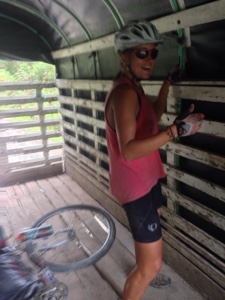
The next morning, the road flattened out a bit and we cruised to La Palma.  In town, we started talking with a guy who was about to drive his truck to the next town, and he agreed to take us along.  Happy to be done with riding on this awful road, we stood in the truck bed, our bikes on the floor, and enjoyed the scenery going by.  Even though Arcabuco was only 20 km away, the truck took hours to get there.  On arrival, the driver refused payment, nice guy that he was, and we rested after our super tough morning with a delicious lunch (more rice and eggs with veggies and, this time, some cheese almojabanas).

A long flat section near La Palma. The speck on the road in the distance is Tam.

Bouncing around in the back of the truck

The ascent to Arcabuco, as seen from the truck

From Arcabuco, we were excited to ride on some better roads to Villa de Leyva, and we choose the slightly longer, well-surfaced version, stopping at a nice waterfall in the middle and reaching Villa de Leyva around 4.  We found a steal on a hospedaje, which, ironically, is called Sueños de Daniel (Daniel's Dreams), and set about exploring and enjoying this beautiful colonial town.  

Cascada La Periquera

Villa de Leyva's picturesque main square

Route notes for other cyclists:
- Highway 55 between Soata and Duitama is about 99% paved with beautiful scenery and little traffic.  The traffic picks up a little bit more after Belen, but it's still very manageable.
- The road west from Paipa is paved until almost the top of the pass, where it becomes smooth dirt for maybe 2 km then really rough all the way to Gambita, with the exception of a few short, paved parts.  More of the same rough road from Gambita to Arcabuco, with short, steep hills just south of Gambita and some flats for awhile around La Palma, then a big climb up to Arcabuco.
- About 10 km after Palermo, just before the road starts to switchback up towards Gambita, there is a nice campsite right by a stream.  There's also a beautiful waterfall maybe 100 meters up the road from there.
- Arcabuco to Villa de Leyva: Two options, paved (mostly) or dirt (mostly).  We chose paved, and the surface was really good for awhile.  Somehow, according to Google Maps, we took a turn somewhere and ended up on the dirt one, which was decent as well.  Because, at the intersection of the two, all we saw where GMaps shows the paved road was a rough dirt road, I think their designation of paved/unpaved is wrong in this instance.  When in doubt, follow the better road, not the map.