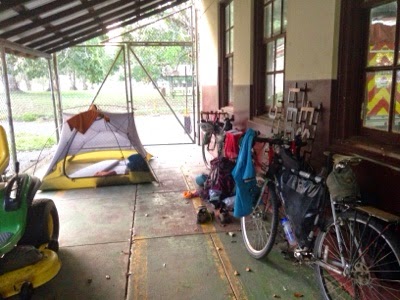
Sunday, May 10, 2015

Welcome to Colombia, May 6th-10th

Cartagena-Turbaco-Arjona-Nepomuceno-El Carmen de Bolívar-Ovejas-Magangué-Bodega-Mompox


May 6th
Rest day in Cartagena! 
After completing our errands (finally we have clean smelling clothes!) we take some time to walk around. Somehow, the charm and life of this city shine through the oppressive heat. Just outside our hotel a small convenience store has been filled with chairs so that fans can crowd in and watch the soccer game on the tiny TV. They're all cheering as we walk past. Out on the main street we find endless carts of street vendors, fresh fruits, veggies, giant avocados, and of course giant thermoses of hot coffee (just about the last thing I want right now). All along the main park are stands selling used books. And people, people everywhere, out and about. 
Our favorite part of the city is the picture perfect old town. Surrounded by thick walls, it is austere and beautiful. The streets are lined with fancy boutique shops and balconies overflowing with flowers, and a decorative plaza or old church waits to delight around every corner. 

The Theater

We end our walk by climbing up on one of the old walls for a view of the ocean. This is the last time we'll be seeing the Atlantic for a while. 

May 7th
Out of the city. 
After saying our goodbyes to John and Huyen, we brave the heat and get back on the saddles.  Getting out of the city is comparable to biking in Beijing. It's that crazy. Motorbikes, buses, cars, rickshaws, people selling things, people with huge carts going the wrong way on the road, or trying to cross the road by slowly inching out into traffic. Horns honking, music blaring, people yelling. It's insanity, but somehow we make it through and pledge to do our best to avoid more big cities in Colombia. 
Finally we're on a nice road with a shoulder, and the traffic dies down. In the afternoon it rains and that helps cool us down a bit. We're biking through farmland, so we decide to ask a family selling mangos on the side of the road if we can camp in their yard. They turn out to be incredibly nice, showing us a place to camp, a place to shower, and loading us up with free mangos. I think they are by far the poorest family we have stayed with. You know that you've reached poverty when there's not even an outhouse, just a small plastic pail. 

May 8th
Trucks and farms
The young boy of the family loves to play baseball, (he played catch with Danny for hours last night) but his family doesn't have money to buy him a real baseball or a glove. We want to do something to thank these incredibly generous people who are so poor but won't even let us pay for mangos. So Danny gives the little boy some money as we leave; hopefully he'll get his baseball glove. 
All day we bike through farm land. At times the road is smooth with a shoulder, other times it appears to have melted and the shoulder goes away. The traffic is equally as fickle. We'll bike for 5 minutes without seeing a single car, then suddenly 3 trailers are passing in both directions. 

Can you fit a bale of hay, 4 buckets, and a mattress on the back of your motorcycle? 

Unfortunately for us, Colombian food stores have nothing that we usually eat. No cans of beans, no instant potatoes, no instant rice, no non-sugary bread, no pre-made tortillas. You either make it yourself with corn meal or buy some soda and a bag of chips seasoned with MSG. 
We decide that the best option for now is to eat out. There are tons of small restaurants along the road and you can get a huge plate of food for $2-3, which is a pretty good deal. For breakfast and lunch we enjoy combinations of yucca root, cheese, rice, beans, tomatoes, and onions. I can't help but think about how I used to teach my 6th graders at High Trails how the Native Americans would eat yucca root. Now here I am eating it. 
We're hot and tired when we reach the town of Carmen and decide to stop to reevaluate our route.
The little hospedaje we find turns out to be clean, quiet and cold, and the nice lady who runs the place cooks up some rice for us. 

May 9th
Off the beaten track
We wake up early, and thanks to the AC overnight I actually feel ready for the day. Thankfully, traffic is a bit less in the morning and our first few miles are pretty relaxing. 
We've decided to try out a new meal schedule; just a small fruit snack in the morning so that we can get going quick, then a larger breakfast later when it starts getting hot and we want a break. Today it's around 9:30 when we stop for big plates of rice, eggs, bananas, avocados, and yucca. Filling and delicious. 
Not too long after breakfast we turn off the main road and on to a smaller one. The road surface deteriorates, but there is significantly less traffic. The majority of people we see are super friendly, waving and giving us thumbs up. Their positivity makes the heat bearable. 
As for scenery, imagine your favorite stretch of rolling countryside, Virginia, Alberta, or wherever, then add some small towns with brightly colored houses and loud music, a bunch of donkeys tethered along the side of the road, and lots of motorcycles. That should give you a pretty accurate image of where we are. 

Late in the afternoon we roll into the town of Magangue amidst an army of motorcycles. Everyone here has a motorcycle; they're like locust swarms on the streets. With some exploring, we manage to find a hotel for $8 in a mostly non sketchy area of town. For dinner: giant fried corn cakes with cheese known locally as "arepas." Way too greasy, but they fill up our hungry stomachs. 

May 10th
Happy Mother's Day! Sending lots of love to our moms!

Neither of us sleeps well. Even with frequent cold showers and the fan, it was still too hot. I think this may have been our hottest night yet. 
In the morning we bike a short ways to Yati, a small town along the river where we're hoping to catch the ferry to Bodega. (There's no road across the river here, so boat is our only option.) Upon arriving we hear that the ferry isn't running today, so we opt to take a long wooden motor boat instead. The guy tells us that the boat will be leaving at 9, so of course we end up leaving at 10:30. 
Once in Bodega we begin down a 38km bumpy gravel road to the historic city of Mompox. 

It's a long ride. The sun is beating down, there is little shade, and every town we pass is blaring ear splitting music. We're used to restaurants and bars playing music, but along this road houses have full stereo systems as well. Neither of us can bear to sit down at any of the restaurants due to the music and large groups of single men drinking beer. It is clear that Sunday is a big day for drinking. We end up just skipping lunch. 
Once in Mompox we find a hotel with AC. Oasis! 
A bit later when we go out to find food we discover that the town of Mompox is pretty cute. There's a green park along the river and lots of old refurbished churches and plazas. 
The plaza de comida has giant pizzas for $7. I smell dinner! 

Wednesday, May 6, 2015

The Voyage to South America, April 29 - May 6

Here´s the scene:
Capt. Jack´s rooftop bar.  Travelers are packed around the small tables, all seemingly in a daze, plugged mindlessly into their electronic devices. No one looks happy.
One beer-stained table in the corner however, is filled with 5 smiling people and a lot of laughter. This is where our trip begins.

Cast of characters:

Capt. Dani: Originally from Spain, he has worked on a sailboat running this same trip for 6 months, but this is his first trip as captain of his own ship. Small and agile like a monkey, he has a limited grasp on English. Nonetheless, he manages to be hilarious and positive at all times, mostly with the use of the words ¨Hi!¨ ¨C´mon!¨ and ¨Achooo!¨

Engineer Jonathan:  Originally from Barranquilla, Colombia, he´s a big strong guy with a friendly and easygoing demenor.  In charge of maintaining all the boat systems during our voyage.

Huyen: Originally from Vietnam, she´s a fellow bike tourist who loves to talk and share adventures.

John: Originally from Pensylvania, he has lived in Guatemala for 3 years and explored all over Central America. With a easygoing attitude, he´s basically impossible not to get along with. (John joined us on day 2 of the voyage.)

...and us.

The Vessel:

46 ft. Arctic Front.  Originally from the US, she is now ready for the tropics with new snorkel gear, big cushions for lounging above deck, a great kitchen, and a shower.
There she is! 
Bikes on board.
When you look up...

The Adventure Begins...

After meeting Capt. Dani and Jonathan, we go out to sleep on the boat with them.  Danny and I have a private room at the back with a huge double bed complete with foam mattress pad. Sweet! We´re excited to finally be on our way to South America.
The next morning we have to go back to shore to pick up bikes and last minute groceries. It´s a relaxed day. We sail a bit in the afternoon and anchor in the port of Porvenir for some swimming and reading time.

Overnight we sail to the San Blas Islands, aka. Tropical Paradise! Water so clear you can see down 40 feet, amazing reefs filled with brightly colored corals and fish, tiny islands with only white sand and palm trees, you get the picture. 

The water is so clear!

On our first day, our crew go off to border control in a small dugout canoe paddled by one of the local indigenous people, the Kuna. This may be the most unusual border we have crossed yet.  While they´re dealing with the logistics, we go snorkeling!
It´s basically impossible not to have a good time in these islands.  During our two days there, adventures included snorkeling around three different shipwrecks, playing volleyball against the tourists on another sailboat doing the same trip, and eating seafood paella made with freshly caught fish over a fire. Our captain is a superb cook.  
Jonathan and Dani at the Paella Fiesta

Too soon, it´s time to take to the open ocean.  We leave at midnight and when we´re awake the next morning there´s no sight of land, only big waves.  And, wait, dolphins! Suddenly a HUGE pod of dolphins has surrounded our boat, jumping and playing alongside us in the waves. We all forget about being seasick as we watch them.
When the dolphins leave, we resort to simply lying in the shade above deck and trying to sleep or relax.  In the rocking waves, it´s almost impossible to be below deck or focus on anything (like a book). Somehow, Capt. Dani is not seasick at all and is able to cook amazing meals for us in the swaying kitchen below.  We do our best to eat because the food is just so delicious.
We continue all day, the next night, the next day, the next night... There are problems with the motor and battery, so we sail most of the way and it takes longer than expected. But luckily the weather is nice, we have a full moon, and everyone remains positive on board. 
John with the broken engine belt.

At approximately 3am we arrive in the Islas del Rosario off the Colombian coast, but we can´t safely make a landing due to the surrounding reefs and our unreliable motor.  Instead we drift around a bit until a new character enters our story.  Meet Manuel, aka Captain America, former captain, boss of Dani and Jonathan, and bottomless pit of drinks and funny stories.
Manuel, his voice booming at a rather uncomfortable volume in the early morning, drags us into harbor with a motor boat, and helps us get things fixed up on the boat for the final sail to Cartagena.  
Getting towed in.

For the afternoon, we all jump overboard and go snorkeling.  There are more beautiful corals and fish and perfect white sand beaches to explore!
The following day we finally reach our destination of Cartegena, but due to border politics we don´t get our passports back before it is dark. We spend our afternoon ogling at the skyline of Cartagena and watching giant cranes load goods onto huge container ships.
Downtown Cartagena 
Look at that ship! 


May 6th
We set foot officially on South America! We´re spending today doing some laundry, route planning, miscelaneous errands, and exploration of the beautiful old city.

Thanks to all our new friends for all the laughs and an unforgettable maiden voyage on the Arctic Front!


Tuesday, April 28, 2015

Ukuleles, Sloths, and A Big Canal, April 25-28

Our day in Panama City included some errands and a wonderful jaunt around the Metropolitan Park, a tropical forest within the city limits.  We walked a few of the trails, finding loads more than we ever expected to.  Most interesting without a doubt were the leaf-cutter ants.  We came upon one of their thoroughfares across the trail, a deep groove eroded into the leaf litter and dirt by millions of tiny steps.  
The ants without leaves were heading for the trunk of a huge tree, climbing 
vertically hundreds of feet to the top, finding a suitable leaf, and then descending with their package back to the ground and the nest, which we later found to be about 50 feet from the tree.  The ants don't actually eat the leaves; when they return with their onerous packages, they deposit them to the capable jaws of another caste of workers, who then feed the leaves to a fungus that they're cultivating underground for food!  There are other castes, too, not involved with food production.  We observed an immense amount of ants bringing a whitish substance out of the nest little by little and depositing it a few feet away, perhaps cleaning out the garbage?  The mound they were making was already a few feet high.  The organization and structure required to make all this happen simultaneously, with surely much more happening that I don't know about, is mind-boggling.

In addition to the ants, we saw tons of birds, of course, and two wonderfully cute sloths!  
We were even lucky enough to observe one in between its 20 hours of daily naps.  Less fun were the park's informational signs, snooze-inducing placards with technical language about mosses and other bryophytes.  We were also disappointed by the fact that we only saw a few other people on this beautiful Saturday afternoon.  Where was everybody?

The next morning we biked out to what we've heard to be Panama's main attraction (just beating out the sloths): the canal.  We marveled at the ingenuity of the system, at the fun that the engineers must have had thinking up ways to move massive ships from ocean to ocean.  A few ships passed while we were there watching, helped to get in position by two tugboats and then guided through the locks by a number of tiny train cars on the edge of the concrete dividers, their tracks inches from the dropoff to the murky water below.  

Our bikes at the canal

If you look closely at the picture above, you can see a small package attached to the side of each bike.  We bought cheap ukuleles in Panama City!  The perfect travel instrument, they take up very little room and weigh almost nothing, and we're super excited to have more music in our lives.  We've waterproofed, padded, and attached them securely; we'll see how long they last.

With the canal, the railroad, the roads, and the wildlife corridor connecting the Pacific and Caribbean coasts, a lot of things here are on the move.  Including us, though not very far today.  After watching a few gargantuan cargo ships squeeze through the Pedro Miguel locks, we biked out to Gamboa, walking across a horribly rickety, one lane bridge in the process, our sights set on Soberania National Park.  We eventually set up camp in the forest along the Pipeline Road, a world-renowned bird and wildlife watching spot.  As night fell, it seemed like all the animals were at the foot of our tent, because every few seconds there was a new hiss, chirp, grunt, moan, croak, crash, whine, or whistle, sometimes together, often very near, and always superimposed upon the constant thrum of the jungle.  The dense greenery itself seemed to be contributing to the din. It was quite an experience to be out there in the middle of all of it, sweating away.

The next day, a late morning walk on the Pipeline Road drained our energy, as extreme heat and humidity tend to do, so we spent the rest of the day at the Gamboa park making vague, music-like sounds on our brand-new ukuleles.  We were going to camp in the park but decided to ask the firemen, whose station was adjacent to the grassy space, if we could instead set up on their lawn.  They acquiesced and, even better, offered us use of their exclusive pool!  We followed one of the firemen to the pool, finding out that the word "pool" was an understatement for this aquatic complex.  A 12-foot diving well, a 25-yard competition pool, and a kiddie pool were together dwarfed by a peeling white grandstand, the only writing on which was, in large, official letters, "NO NECKING."  For the only rule, that seemed a poor choice.  

Our bikes at the fire station

Really the pool was probably built by the U.S. when they controlled the canal, and it's fallen now into the hands of the municipality, who has no idea what to do with it.  Other than using it as a large billboard to enforce prudence, of course, and giving overheated bicycle tourists an unexpected respite from the heat.

Our next morning ride was pretty uneventful, humid but shaded in the forest, and we then attempted to take the toll road north to Colon.  For the first time ever, we were stopped by a policeman and told to turn back and ride on the smaller road.  We offered to pay the toll and explained that riding on the smaller road, though it seems safer because of reduced speeds, is much more dangerous for us because there's no shoulder, no space to ride.  No luck.  He responded by saying that we were here just because it's shorter, not safer.  We declined to argue, turned around, and hopped onto the dreaded shoulderless road, which actually did have a gravely shoulder some of the way and wasn't as horrible as we had thought it might be, partly because it had mango trees!  We ate four right there, at the biggest stockpile we found, and a whole bunch more throughout the day.

The rest of the day brought us, again for the first time on this trip, to the shores of the Atlantic Ocean!  Woohoo!  We arrived in the port town of Portobelo, where, tomorrow, we are going to board a small sailboat that will bring us, over the next five days, to the San Blas Islands on Panama's northern coast and ultimately to Cartagena, Colombia.  South America, here we come!

Friday, April 24, 2015

Mega Skyline: Panama City

This morning, up bright and early, we nabbed a bus to Panama City.  There's no more construction after Santiago, but we had read that the Pan-Am, the only option, stays big and trafficked all the way.  Normally we would find different roads to take, but in Panama there just aren't other options. Knowing that the riding would be hot and stressful, we made the decision to spend our time in Panama enjoying the parks around the canal instead. 

Setting foot in Panama City was like entering another world.  Shiny, chaotic, and sweaty come to mind, only a few of the many adjectives that could be used to describe this cloud-scraping megalopolis. 
Luckily, it wasn't too hard to find our way out of the busy streets and out onto a newly constructed bike path. We spend an awesome afternoon cruising the green space along the coast and checking out the new biodiversity museum.  
Part of the impressive skyline
Quite a contrast from the rest of Central America! 

The Biodiversity Museum, building designed by Frank Gehry

Bridge of the Americas, Panama Canal


Panama!!!

"Should we go to Panama?" Tam asked me this morning as we stood facing the road, packed and ready to go.  "Yep," I replied, grinning.  We were ready to take on the next country, our last in Central America.  But it wasn't that easy.  About 30 km of shoulderless, trafficked road lay between us and the border, and while we knocked it out pretty quickly, it certainly was stressful.  Trucks and buses and whatnot.  Anyway, the border still snuck up on us and the bureaucracy wasn't too tough to negotiate, so soon we had our feet on the soil (ahem, pavement) of Panama!  The road was much wider than that on the Costa Rican side, all the trucks were forced to wait at the border, and we had a tailwind, so, despite the humidity, we enjoyed the ride.  Yet, as we approached the city of David, Panama's second-largest, our shoulder turned to gravel and the traffic increased to the point of being an almost continuous line. The last few kilometers were slow while navigating the shoulder and the trucks, and finally we made it into the city, where we're staying at a hostel.  

I didn't take any pictures today, so here's one from the archive:
End of the Dalton Highway, northern Alaska

Tonight was spent planning: there's only one road that connects here with Panama City, and it's under construction for about 200 km, so we hear, and then very busy near the city.  Not too many riding options.  As for tomorrow, we're going to head north into the mountains, to, and perhaps past, Boquete.