Showing posts with label Mexico. Show all posts

Sunday, March 8, 2015

To Guatemala! March 7-8

Our last night in Mexico was also one of our best of the entire trip.  After enjoying the day biking, resting, and hanging out with our host family, we had the pleasure of sharing Tam's birthday with a whole bunch of new friends from around town and the cycling club in Las Margaritas, TzejeBike.  We sang songs and ate pizza, Tam took a bite straight out of the cake, and there were even gifts!  On our new cycling shirts, we will from here on out display proudly the TzejeBike name and logo.  Tam also received a beautiful amber bracelet and a dressy shirt.  Later in the evening, Luis brought out a guitar and I played some favorites.  No one knew the songs but us, but Wagon Wheel is catchy in any language!


Many, many thanks to Luis, Mario, Carla, the whole family, and everyone else who joined us for an unforgettable experience in Las Margaritas!

The day's ride took us down into a big valley, and then past Ciudad Cuahtemoc, which is really nothing more than a tiny village, up into the border zone.  
The approach to Guatemala

The Mexican immigration office is in Cuahtemoc, the Guatemalan office four kilometers away across the border in La Mesilla.  "Town" is too nice a word for La Mesilla; it's just shop after shop along both sides of the road selling food, shoes, phones, and just about everything else.  The border itself, the reason for the "town," is less than imposing: it's just an open gate.  People were walking through both ways without so much as a pause, and we joined the crowd and crossed the border.  Confused, and wanting to enter as legally and officially as possible, we sought out the building marked "immigration."  Keep in mind that this building is just one of the hundreds on the side of the road, and that there are no big signs, or even little signs, telling you where you need to go.  You really have to work to enter Guatemala legally at La Mesilla.  Once inside, though, a guy flipped through my passport, scrawled a barely legible "90" to signify that I had 90 days, then asked for 20 pesos (~US$1.40).  It took less than two minutes.  Tam's experience was even easier (they failed to ask her for the 20 pesos), and we figured we must be missing something.  So we went to customs, again voluntarily, and they took one look at our bikes and waved us through.  Okay, then.  We did fail to get an exit stamp from Mexico, but I'm not too concerned about that.

With the arduous border procedures taken care of, we found a hotel there for 50 quetzales (~US$8) and settled in for the night.  Later, two fellow travelers, Danny and Ibrahim, from Mexico and The Netherlands, came to hang out, and we enjoyed talking with them late into the night.

Our next day's ride to Huehuetenango (way-way for short) started with a huge uphill, and it just kept going up following a beautiful river.  Through canyons with steep narrow walls and into the mountain highlands we went, adjusting to Guatemala as we went.  New currency, new dialect, new culinary customs, it was a lot like Mexico but also very different.  

At one point when the canyon was extremely narrow, a motorcycle passed us, and we saw its two riders, late teenage males, again around the next curve, a few hundred feet away, stopped on the side of the road.  There was no one else around and little traffic.  It sounds benign, as we see cars and motorcycles and trucks stopped on the side of the road all the time, but this was different.  Tam and I both had a horrible gut feeling that they were waiting for us.  We stopped and watched as they beckoned to someone we couldn't see around the corner.  Another guy came into view, an older guy with a machete (again not cause for alarm in itself, as everyone has a machete, but still).  We watched some more and tried to look nonchalant; they looked back at us and also tried to look nonchalant.  After a few minutes of this, a pickup truck with about twenty people in the back came along, and we decided to act.  We rode way out in the road so the truck would have to slow and stay behind us.  We biked by the three guys, smiling and saying buenos días, then continued on our way.  We didn't see the guys again, and I hope we were wrong about their intentions.

For the rest of the day, little concrete and wooden huts lined the road on both sides wherever there weren't sheer walls.  Most of the inhabitants of the area are Mam Maya and speak Spanish as a second language, but they all, from the littlest kids up, know the word gringo.  Here's a typical conversation we might have with someone we're biking by:

Us: "Hola, buenas tardes!" (Good afternoon)
Them: "Gringo gringo gringo!"

I kid you not.  It got pretty old after awhile, being judged solely by our skin color.  For all they know, we could be from Latvia.

We arrived exhausted in Huehuetenango, immediately got some of the ubiquitous Guatemalan snack "chocofruta," which is fruit dipped in chocolate, and headed to meet up with Rolando, a guy we had met the night before in La Mesilla.  We enjoyed a typical Guatemalan dinner at his restaurant, the most flavorful and delicious meal I've had in awhile, then got a cheap but comfortable hotel in Huehuetenango.
Marlen and Rolando, good people!

Our location now:
 

From Huehuetenango we're going to head east towards San Cristobal Verapaz and Coban rather than south on the Pan-American Highway towards Lake Atitlán.


Friday, March 6, 2015

Happy Birthday Tam! Chiapas Adventures, March 1-6

The Ruins at Palenque Rising From the Jungle

We left Tuxtla late in the morning, saying goodbye to the guys atTuxtla en Bici, passing by the mouth of the beautiful Cañón del Sumidero where we had spent some good time the day before, and then beginning to climb.  We had heard that there was some uphill, and we found soon that "some uphill" is a big understatement.  It's all uphill for almost 35 miles.
Yeah.... that looks about right.

But, with our aching muscles also came cooler, fresher air and a beautiful view of the valley below.  After awhile the valley floor disappeared in the haze, creating a wonderful floating feeling when we looked down.  
The environment soon changed, too, from shrubs and grasses to pine forest, a welcome change.  On both sides of the road, around the numerous indigenous villages, were steep tracts of land cleared for farmland.  There is no flat land anywhere on this mountain, so the people here make do with what they have.  Were we to go back in time a few hundred years, I bet this area would look very similar to today.  
Max saving his legs for later

Hours later, we were still going up.  Fatigue was setting in as our shadows lengthened, and suddenly we heard a loud pop from Max's bike.  He stopped, looked, and swore in French.  A spoke had broken, and so close to the top!  We could fix it, like the one we had fixed a few days before, but there just wasn't time to remove the cassette, thread in the new spoke, put the cassette back on, and true the wheel.  He would have to hitchhike.  We made plans for later then continued up, still up, forever up through canyons and forest and now-chilly air.  Max passed us a few minutes later, grinning and waving from the back of a speeding pickup truck, and shortly after that we finally saw our destination, San Cristóbal de Las Casas, way down (!) in the next valley.  Flying downhill after an entire day of climbing was like a dream, though by now it was legitimately cold. The mountains, the clouds, the city below, and the sun hitting them all just perfectly with the last rays of the day all came together to form a landscape that I can still see clearly in my mind.

Down in San Cristóbal, dusk setting in, we saw Max beckoning to us from a gas station parking lot.  He was surrounded by motorcycles and men wearing leather, and when we got closer, he introduced us to Abel, a motorcyclist who had invited him, and us by extension, to his house!  Max's bike was non-functional, so we loaded up his stuff on our bikes and he hopped on the motorcycle, bike in hand.

Abel and his family were all very nice, like 99% of the Mexicans we have met, but one of his friends was not so welcoming. In his eyes, anything not Mexican was not good, and anything gringo was worse.  His idea of welcoming us to beautiful and wonderful Mexico (in which we had traveled more than him) was to tell us how everything Mexican is great and how everything American, from the food to the people, is inferior.  It quickly became apparent that he didn't actually know anyone from the United States, and that his viewpoint had been shaped by the news media and by the small community of ex-pats in San Cristóbal.  It was difficult to bite my tongue, but nothing good would have come of rebuttal.  Fortunately Tam was there to elbow me every time I tried to open my mouth.

I was angry at this guy at the time, but now I can't help but empathize with him.  Even though immigration reform was just passed in the U.S. to be more amenable to Mexican-Americans, if all I knew about the U.S. were its immigration policies towards Mexicans, I would dislike it too.  And I can't help but see parallels between his closed-minded ignorance and that of so many people in the U.S.  Of all the people who told us we would get robbed or worse in Mexico, how many had actually been there?  How many actually knew any Mexicans?  Mexico and the U.S. are very different places, yes, and there are definitely places I would not go in either country, but this guy showed me again what I've already learned many times over: that it's irresponsible and wrong to judge an entire country or people based on either the stance of their government or what is reported in the media.

Some late-night tacos made everything better, and we spent the next day getting to know San Cristóbal de las Casas with Max and planning the Guatemala section of our trip.  San Cristóbal is a beautiful town, modern and clean, with a rich indigenous cultural history.  It was one of my favorite cities in Mexico, rivaling Guanajuato.  
San Cristóbal de las Casas 
Photo Credit: www.michaeldemeng.com

The day after, we woke up super early and boarded a "combi," a large van, to see some places a bit off our route.  Bicycling is all about getting to know the places between the places; today we would be going destination to destination.  The bus was hot and cramped, and the roads extremely mountainous with hundreds of potholes and speed bumps.  Fortunately the bus broke down about 20 minutes out of town, and we took the opportunity to stretch our legs and let the nausea subside by hiking up a nearby hill in the cool pine forest.

Too many hours later, we turned onto a side road to the Agua Azul Waterfall.  Just before the entrance was a rudimentary pay station, the gate a rope across the road, with a sign explaining that your 15 pesos would be funding the Zapatista movement.  We knew Chiapas was a hotbed for activism, especially for the Zapatistas, a largely indigenous movement based on land reform that culminated in their 1994 takeover of a few cities.  Then the military moved in, and not much has been heard from them since.  This was the first sign we had seen of their presence.  

We spent an hour at the waterfall enjoying the lacy cascades.  The color of the water reminded us a lot of lakes and rivers in the Canadian Rockies, though the source of the color is different.  

Max, me, and Tam

After Agua Azul we headed to Misol-Ha, another waterfall.  We swam and explored the area; interacting with the place made it mean so much more.

Finally to our final destination: Palenque.  I'm usually not a huge fan of ruins, but Palenque, with its ancient Mayan temples and palaces surrounded by sweaty jungle, was absolutely incredible.  Scaling the pyramids, wandering the passageways, marveling at the jungle vegetation and wildlife, it was all amazing, and I found myself regretting that we hadn't set ourselves up to spend more time at this mysterious and impressive site.


We also enjoyed the company of Dilah, an Indonesian student currently living in the state of Oaxaca to study indigenous methods of making textiles.  She was really interesting to talk with, and I'm sure we'll see her again in Indonesia!

We found ourselves back in San Cristóbal around 10 pm, utterly exhausted but glad we took the time to see these places.


The road from San Cristóbal to the Guatemalan border is roughly 180 kilometers, two days' ride, but we decided to take a short detour to El Chiflon, another huge waterfall.  The ride was almost all downhill, and the waterfall had a legitimate campground attached!  We had a nice nighttime swim.  Unfortunately, that night we also realized that we had left the Spot device, our GPS, at our lunch spot.  I can't express how idiotic and stressed we felt, and I spent the next morning taking all kinds of motorized transportation to try and get it back.  No luck.  Compounding our loss of the Spot was the fact that the replacement phone cord we had bought in San Cristóbal was not working, so we were unable to contact our parents at all. We had no choice but to go to the next city and see what we could find.

The road to Comitan was all uphill and steep, and starting in the middle of the day after my hectic, expensive, and ultimately fruitless morning, was absolute hell.  It must have been 100 degrees.  But we soldiered on, finally reaching the outskirts around 5 pm.  Never had I been so glad to see a shopping mall!  We ran in, found a functional phone charging cord, and let our parents know what was going on.  We also started talking with a really nice family who invited us to their house!  They live in the city of Las Margaritas, and while there was some confusion at first because we thought they wanted to take us out for margaritas, we ended up enjoying a wonderful night of food and family.
Our hosts were Luis, third from the right, and his son Mario, second from left.  They live in a large compound with all of their extended family, and they all mountain bike, from the grandmothers to the little kids.  The next morning, we went on a short ride with them and some friends from the local cycling club.
Tam

Jesus and Daniel, some young friends 

In the afternoon, Luis showed us around the nearby city of Comitan, where he used to work as a school administrator, and we had some great conversations; Las Margaritas, where they live, is the original home of the Zapatista movement.  Today also happens to be March 6, Tam's birthday!  The family made a decadent comida (the largest meal of the day, eaten around 3 pm), and we got a cake to share later!  I think Tam would agree that it has been a wonderful start to her 25th year on earth.


Saturday, February 28, 2015

Chiapas!

Feb 26th
We entered our last state in Mexico today. Hola Chiapas!

Thanks again to our hosts Rodrigo and Lupita! We can't thank you enough for everything.


We invited our new friend Max to ride with us today. In the morning we all attempt to leave early. Unfortunately Danny gets a flat tire first thing. Despite the delay, we manage to leave quickly and once  we're on the road we make good time. Suddenly one of Max's spokes break. He offers to hitchhike but we have spare spokes and decide to take this as an opportunity to learn how to fix a broken one. It takes a while but eventually we are successful! Max's wheel holds up well for the rest of the day. 
Danny and Max struggling to pump up Max's tiny road tires. 

Inevitably we start our climb into the mountains as it is starting to get uncomfortably hot. Luckily, the scenery is beautiful and the road has so little traffic that we can ride three across and talk.
Max 

Near the top of the hill we stop for lunch in a little town. It's hard to motivate ourselves to get going afterwards, but when we do we find ourselves desending into a wonderful valley. Unfortunately, on the descent one of my shiftng cables breaks. What is wrong with our bikes today? It is only beacause of an amazing tailwind that we make it to our goal destination: Cintalapa. Here we meet some amazingly friendly firefighters who let us camp at the station. We use their stove to make a pasta feast for dinner.
Sunset behind the fire station 

Feb. 27th
We sleep very well outside the fire station. Thankfully it's a cool night and the next day is overcast. The traffic on our road has increased, so when we reach an intersection with the toll road we hop on it.  Toll roads always have nice shoulders for us to ride on, and this morning we have some beautiful mountain scenery to enjoy as well. 
The Maseca factory! (The company that produces corn flour for basically every tortilleria) 

We get into Tuxtla (the capital of Chiapas) around lunch time. After fighting through the typical mess of traffic on the city edges, we spend our afternoon trying to get pills for malaria prevention and food shopping. 
Yep- everyone is piling their garbage in the middle of the street. Why? Apparently no one wants the pile next to their house or business, so in the middle of the street it goes.

Errands completed, we make our way to Tuxtla en Bici, a house for cyclists sponsored by the Tuxtla cycling group. Here we meet Roberto, founder of Tuxtla en Bici, an extremely friendly and energetic young guy. He tells us all about different bike rides and clean air initiatives in the city. There are a lot of great events happening here! 

Cool posters promoting cycling and cleaner city air

As the evening progresses, more and more people come over and it turns into a full fledged party that lasts until 3 AM. We try to go to sleep around midnight with little success.

Feb 28th
After a night of little sleep Danny and Max spend all morning trying to get their second dose of the Hepatitis A vaccine. Apparently most people in the health care system are incompetent and it's next to impossibly to try to get something. They go to 4 different places before finally receiving the vaccine. In the afternoon we take a trip out to visit El Cañón del Sumidero, a large canyon right next to the city of Tuxtla. The canyon was originally formed by the action of a geological fault and then further carved by rivers flowing from the nearby mountains. At some point, a dam was created and the canyon partially flooded. Thus, now the water is calm without a noticeable flow and is only disturbed by the motor boats that zoom up and down.
To reach the canyon we take the public transport known as "Colectivos"- small cars in which they cram far too many people. When we reach the entrance to the park we check out the map and learn that if we want to hike in for a view we'll have to walk up an 18 km road. As we try to decide what to do, a pickup truck pulls up and offers to give us a ride. The people in the truck are extremely nice and take us to all of the viewpoints. 
The true Mexican experience- too many people in the back of a truck. It's a negative stereotype in the US, but in Mexico, it's something we see all the time.

On the way up we also get a great view of the whole city of Tuxtla nestled into the valley. We enjoy seeing the canyon with sheer walls more than 4,000ft tall and jungle-y vegetation. But even from up here I can see trash from the city glittering in eddies of the river and it seems sad that this natural place has been altered so much by man.
The city of Tuxtla 
Beautiful canyon
In the evening we go out for a special treat- pizza! But pizza is very expensive here so we supplement our dinner with tamales.
Delicious!


Wednesday, February 25, 2015

Zanatepec, February 24

Rodrigo, Lupita, and the youngest of their three children

Rodrigo, our host in Zanatepec, is an English teacher, and he invited us last night to speak this morning with his class.  How could we refuse?!  Due to the late start of his classes, the heat, and the 3,000 foot hill that lies about 13 miles from here, we decided to stay for the day in this little Oaxacan town.

Unlike our last two class presentations, which were more like, well, presentations, this one was more of an interview.  We were introduced to the 15 and 16 year old students as not knowing any Spanish in order to force them to speak in English.  They asked us a few questions, but their grasp of the language was tenuous at best, so they were reluctant to speak up.  We soon revealed our mild capability in Spanish and lapsed into that language, and the students became more talkative.  It was quite a challenge, being interviewed in Spanish, but I think we did pretty well!  

Rodrigo then took us to a guy he knew who sews and makes clothes, so that we could have our homemade frame bags reinforced.  The guy, with his old, mechanical sewing machine that far outpaced the fancy one we used to originally make the bags, expertly followed the stitching and finished both of our bags in maybe 30 minutes.  
He told us it would cost 30 pesos (~$2.25), which seemed to us to be way too little, so we thanked him profusely and tipped him well.

The rest of the day was spent reading (I finished Rushdie's The Jaguar Smile and moved on to The Time Traveler's Wife [gasp, fiction!), eating, and hanging out with another cyclist, a French Canadian named Max who is spending tonight here as well.

Mangos and Wind

February 23
We left Jalapa really early to get in some miles before the heat set in, and, with the help of a tailwind, rode hard for a few hours and made some ground.  
Early Morning Sun Rays

Then we turned on to a toll road to bypass two small cities, and, though it was nice riding with no traffic and a shoulder (how often does that happen?!), we changed directions and found ourselves with a headwind.  Still, it was nice riding.  We had passed out of the mountains and had entered the coastal lowlands; flat, shrubby palms dominated the landscape.  
We went almost 70 km before we stopped for lunch, and good thing, too, because the mild headwind picked up and turned into a vicious crosswind.  By pedaling hard and maintaining speed, we could withstand the worst of gusts without falling, but there's only so far you can lean before the wind wins and your wheels slip or you go off the road.  We had to walk some sections, but that wasn't much better: the stronger gusts would lift the rear wheel off the ground, skidding it over to the side.  I imagine this is what a being in a hurricane would feel like.  

I was proud to see that the wind was at least doing some good.  Rows and rows of windmills stretched for miles, rivaling or surpassing, it seemed, the number of turbines in the Banning Pass area near Palm Springs, California.

We arrived around 5 in the small town of La Venta, where numerous people seemed not to have noticed the gale outside.  "Oh, this?  This isn't bad.  You should've seen last month!"  I'm really glad I wasn't here last month.  None of the doors in this town open to the north, where the wind is coming from, and I understand why.

The police told us we could camp at the recreation center, anywhere we wanted on the paved soccer field.  Remembering the last sleepless night near a soccer field and making sure this time that there were no games later, we ate dinner with confidence that sleep would be in our future.  Until, that is, a guy with a whistle showed up and told me there would be games tonight from 7-10.  Which meant there would be people making a lot of noise until 11.  Now we're camped on the marginally better second floor of the rec area.  The wind is still blasting.  

February 24
...and it blasted all night but was less powerful when we left early in the morning.  
The ride was uneventful and beautiful, the mountains giving our eyes a worthy place to rest.
We arrived before 11 in the small town of Zanatepec, the site of a Warmshowers host we had contacted previously, and enjoyed a leisurely afternoon with Rodrigo, his wife Lupita, and their three "naughty" young boys.  Zanatepec is situated on the only main road leading from Oaxaca to Chiapas and farther south, so this family hosts a lot of people.  At one point they had 11 at one time!  But they have the space and are incredibly generous, and they've been able to experience the world- or at least people from all over the world- without leaving home.  It's the very beginning of mango season here, and we picked the riper ones and spent a good few hours just eating mangos fresh off the tree.

Rodrigo also told us that when the wind in the section we just came through is really bad, he frequently sees trucks rolled over and people on bikes stranded, unable to walk or ride.  We were fortunate.

Sunday, February 22, 2015

Oaxaca Ups and Downs, February 18-22

Oaxaca's topography: mountains, mountains, and more mountains

February 18
We said our goodbyes early in the morning to Alfonso and Alicia and headed up the hill.
Thanks guys!

Huajuapan is in a valley, so any way we went, we knew it would be up, and when you're prepared, the hills seem just a bit smaller.  So up and up we went, then down and down into the next valley, where there was a small river with a couple of waterfalls!  After being in the desert for so long (and still surrounded by cacti), the sight of this river was therapeutic.  
We stayed a few minutes then headed up the next hill to the town of Tamasulapam, stopping for lunch shortly after.  Lunch was awesome: queso blanco, avocado, and cucumber wrapped in pitas (Arab tortillas they're called here).  Crunchy, creamy, salty, and all freshly made and bought that morning!

It's always a crapshoot when you look at a 2-D map and try to decide whether the road is going up or down.  Sometimes all you see is a squiggly line, and you know that you'll be going either really fast or really slow, but you don't know which.  
This time we thought we had it figured out, but after the "pass," we kept going up, and up and up some more!  We must have been over 8,000 feet.  A group of supported cyclists on a weeklong tour was also heading up, and we chatted with them a bit before they blew past us easily on their unloaded road bikes.  

Finally, the top!  The descent into the next valley was fantastic but nowhere near as long as what we had come up.  We talked with the supported cyclists again as they visited what must have been a centuries-old church, and we saw them a third time as we pulled into the town of Nochixtlan.  The riding at the end of the day had been in a valley, which meant it was flat!  More or less.
Beautiful, flat valley

The hotel that the supported tour guys (and one gal) were staying in was a good deal- 200 pesos or roughly $14 US- so we stayed there, too.  And we didn't mind lugging our bikes up five flights of stairs, because it was quiet all the way up there (and a nice guy carried Tam's bike up for her).

February 19
Oaxaca City!  The toll road into the outskirts had a great shoulder, and we enjoyed going farther down each downhill than up each uphill.  The actual city, like most cities, wasn't so easy to bike into.  The taxis and buses were crazier here than anywhere we had seen.  
Here there are four lanes, but the middle two are going in the wrong direction...

Teachers striking in the Zocalo

While we were excited to visit Oaxaca for a number of reasons, peanut butter was one that you might not expect.  We officially renounced our search to find peanut butter without hydrogenated oils and sweeteners and gave in to the reality of eating Skippy, and Oaxaca was the first place where we could find it.  Oh, how far we've sunk.  And oh, how good was that Skippy with some freshly ground chocolate.

After visiting the main plaza, we headed over to the place of a Warmshowers host, Lauren, and had a great time hanging out late into the night with her and her partner, Kiefer.  We had wanted to update the blog there, too, but I think we got our priorities right: 1) playing with this adorable puppy.


February 20
Lauren rode with us to the farmer's market, a group of stands not too far from her place.  We got some goodies for the road, and I ate a drop of what must have been the spiciest salsa in the world.  The way out of town was super easy; the old railroad was converted into a bike path and takes you all the way past the craziness!

Our first stop was in Tule, where there's the biggest tree in the world (widest, not biggest by volume).
Pretty big.

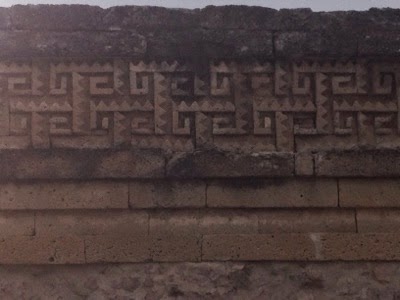
We left late and only had time to get in about a half day of biking, which took us to the town of Mitla.  Here there are groups of Zapotec ruins over six hundred years old, some of which are unrestored and scattered throughout the town.  We arrived just in time to walk around the gated ruins before they closed for the night.  These specific buildings are know for their intricate stone mosaics.


A guy who works to help tourism in Mitla invited us to stay at his house!  We are wary of tourist helper people, as they're usually looking to get their hands in your pockets, but Armando was genuine.
It was interesting to talk with him about the clash of indigenous and Spanish culture, a clash that's still being felt today.  It's easy to see in Mitla; a church stands on top of many of the original structures.  He was interested to hear about Alaska and how things work there.

February 21
The day was already hot when we began.  From Mitla we went up and up, but we were excited to ascend because the higher we went, the cooler it was and the more trees there were.  You could say that we're sick of cacti.  Unfortunately, just as we were reaching the high elevation pine forest, the road took a decidedly downward turn for about 20 kilometers.  
View from the top

Shucks.  Now instead of 80 degrees, it was 90 degrees.  And back up we went.  After the next big pass, we stopped at a little restaurant to cool off.  We don't usually drink anything but water, but a cool can of guayaba juice definitely hit the spot, as did a dip in the river!
Surrounded by cacti

The rest of the day took us through a big gorge with steep walls, the shadows making interesting patterns with the setting sun.
The river gorge

We found a little town and camped out near there next to the river.  The sound of the rushing water, followed by a pre-bedtime swim, made for a restful night.

February 22
The best night's sleep I've had in awhile. I do love rivers.  We woke up super early to beat the heat and immediately began climbing.  All the better; climb in the morning when it's cool, descend in the afternoon.  Again, just as we reached the pine forest, the world fell away and we went all the way back down.  On the way we picked up twelve mandarins, a block of cheese, and two bananas, all for 21 pesos (roughly $1.50), and all of which we ate before and at lunch.
A nice view from along the way

It was super hot at the bottom, and we reached a little town around 1 and stopped for a long while.  No point biking during the hottest part of the day.  The lady who owned the store we stopped at (really the store was the front room of her house) said that the rest of the way was flat, but we didn't believe her.  Flat?  In Oaxaca?  Turns out she was mostly right.  It wasn't just flat; it was waaaay downhill and then flat.  All in all, we must have lost over 7,000 feet of elevation today.  And if we thought it was hot before, being at the bottom of this new valley was like being in a furnace.  Palm trees lined the fields.  For the second time, the first being just south of Mazatlan, I truly felt like we were in the tropics.
We paid a few extra pesos tonight for air conditioning.  The forecast for tomorrow says 94 degrees.